
A mass of pampas grass is spotted by the side of a departmental road, we stop, secateurs in hand, and cut a few stems. This gesture, commonplace just a few years ago, now poses a real regulatory problem. Since 2023, pampas grass (Cortaderia selloana) has been listed as an invasive exotic plant species in France.
The decree of February 14, 2018, amended on March 2, 2023, prohibits the possession, transport, and use of live specimens. The deadline for depleting professional stocks ended on September 1, 2024. Before picking anything, one must check what the law actually permits.
Regulations on the collection of pampas in France: what has changed
The confusion comes from the word “collection.” It is often thought that a cut and dried plume escapes regulation because it is no longer alive. The reality is more nuanced. The regulatory definition of a specimen can include fruits or propagules. A mature plume contains viable seeds, and these seeds are dispersed by the wind over long distances.
It is therefore not enough to cut a stem to consider the collection as trivial. The maturity stage of the plume, the possible presence of seeds, and the interpretation of the decree must be verified with an official source (DREAL, prefecture). When looking for where to find pampas for decoration, the first step remains to ensure that one is acting within a legal framework.
The location of collection adds a layer of complexity. On private land, the owner’s agreement is mandatory. In a protected area, the site’s specific collection rules apply. For roadside verges or municipal lands, one must check the municipality’s guidelines rather than assume that collection is free there.
Dried pampas plumes: legal alternatives for interior decoration
If wild collection becomes legally risky, purchasing already dried plumes remains an accessible option. Dried pampas stems can be found at florists specializing in dried flowers, on online sales platforms, or in certain decoration stores. Commercially sold plumes have generally been harvested before the regulation came into effect or imported from producing countries.
A few points to check before buying:
- The origin of the plumes: reputable suppliers indicate whether the stems come from crops outside the European Union (Argentina, Uruguay) or from stocks prior to the ban
- The treatment of seeds: a properly dried and treated plume should no longer contain viable seeds, reducing the risk of dissemination
- The size and condition of the plume: an intact plume, without broken stems or excessive fluff, lasts longer and produces less residue in your interior
Prices vary according to the length of the stems and the density of the plume. Natural varieties (cream white, beige) generally cost less than dyed versions in pink, gray, or terracotta.
Harvesting period and cutting technique for pampas
For those with a pampas plant in their own garden (planted before the ban), harvesting follows a precise schedule. Plumes are cut between September and the end of October, when the inflorescences are fully deployed but not yet too mature. A plume harvested too late will tend to lose its seeds and filaments at the slightest breeze.
A pruning shear or lopper is used to cut the stems at their base. Pampas leaves are sharp (with microscopic serrated edges), so thick gloves and long sleeves are worn. For transport, wrapping each plume in a sheet prevents fluff from getting everywhere in the vehicle.
Drying pampas grass: practical method
Hanging the stems upside down in a dry, ventilated place for two to three weeks yields the best results. A garage, attic, or garden shed is perfect. Direct sunlight should be avoided, as it yellows white plumes.
A tip to fix the filaments and limit fluff loss: spray hair spray (strong formula) over the entire plume once drying is complete. Apply from a distance to avoid crushing the filaments, and let it dry in the open air.

Incorporating pampas into your interior decoration without cliché effects
The pampas plume has been so widely used in chic bohemian decoration in recent years that accumulation is quickly at risk. The key to avoiding the Pinterest catalog effect is restraint.
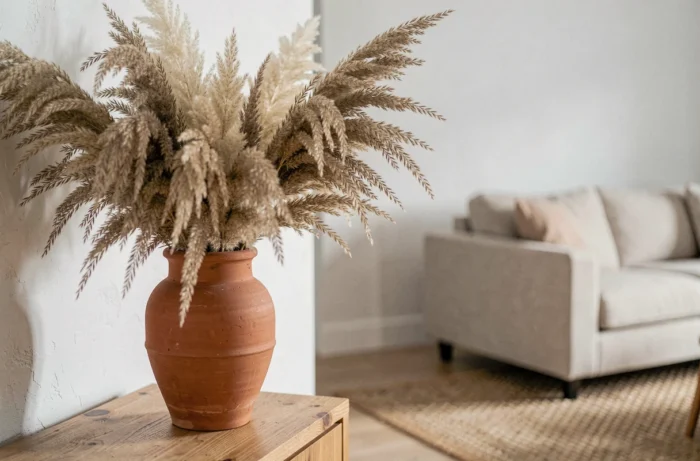
One large vase with three to five stems is enough to create a focal point in a living room or entryway. A heavy container (ceramic, stoneware, thick glass) is chosen to counterbalance the height of the stems and prevent the arrangement from toppling over. Transparent vases show the raw stem, adding a graphic aspect.
- In wall composition: fixing a few short plumes above a console or headboard creates a textural effect without cluttering the floor space
- On a table: short stems (cut to the desired length) in a small terracotta vase work as a centerpiece, either alone or mixed with other dried flowers like eucalyptus or thistle
- In a mixed bouquet: pairing pampas with dried cotton branches, lunaria, or statice breaks the monotony of a 100% pampas bouquet and enriches the texture palette
For wedding decoration, pampas remains highly sought after for ceremony arches or at the ends of benches. Long and bushy stems are preferred, arranged in asymmetrical bundles.
Maintaining plumes over time
A well-dried plume lasts several years. It can be dusted with a hairdryer on a cool setting, at low power. Avoid prolonged humidity, which encourages mold and causes filaments to fall. If the plume starts to sag, a new layer of hairspray can restore its volume.
Pampas remains a decorative element with a strong visual impact, but its regulatory status in France now requires caution. Checking the origin, respecting local legislation, and prioritizing legally purchased already dried plumes allows one to enjoy this grass without contributing to its spread in natural environments.