
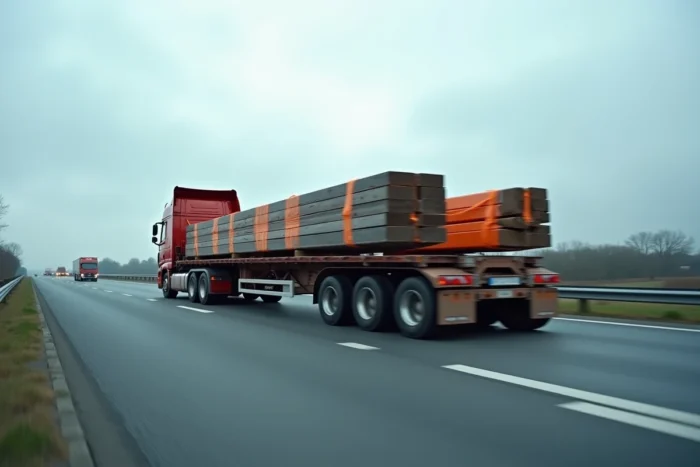
The flatbed truck refers to a truck whose loading surface is devoid of fixed side walls and a roof. This configuration allows access from the top and sides, enabling the loading of bulky, long, or irregularly shaped goods that closed bodies cannot accommodate.
Securing on flatbed: technical constraints often underestimated
On a closed-body truck, the walls help maintain the load. On a flatbed, nothing holds the goods in place except for the securing devices. All responsibility rests on the straps, chains, and bracing brackets fixed to the anchorage points distributed across the floor.
Drivers must calculate the tension force of each strap based on the mass and the coefficient of friction between the load and the flatbed. A steel tube resting directly on a wooden floor does not react like a strapped coil on a non-slip cradle. Underestimating this parameter can cause sliding during braking or turning, with a direct risk of losing the load onto the roadway.
The metal brackets, placed against the edges of the load, prevent lateral movement. Ratchet straps complement the system by pressing the goods downwards. A compliant securing method combines these two approaches: mechanical bracing and vertical tension. Road transport on flatbed trucks requires this double security for each load unit, regardless of the distance traveled.
Open flatbed, tarped, or with sideboards: choose according to the goods
The term “flatbed” encompasses several variants that do not meet the same constraints. The choice depends on the nature of the goods, their sensitivity to weather conditions, and the planned handling method.
Open flatbed
Flat surface with no protection. This is the most flexible configuration for loading by crane or overhead hoist. It is suitable for construction materials, metal structures, framing elements, or prefabricated concrete parts. Any goods sensitive to water or dust are excluded.
Tarped flatbed
A tarp stretched over a frame protects the load from the elements while maintaining the possibility of side loading. Tarping adds a time constraint during preparation, but it expands the range of transportable goods to products that do not tolerate prolonged moisture well (raw wood pallets, certain insulations, rolls of industrial textiles).
Flatbed with sideboards
Removable extensions on the sides hold low-height loads that might slide off the flatbed. This variant is common for transporting logs, bulk pipes, or bales of straw and hay. The sideboards do not replace securing with straps: they add an additional physical barrier.
- Open flatbed: top loading required (crane, overhead hoist, mast truck), suitable for heavy and weather-resistant parts
- Tarped flatbed: protection against rain and wind, side loading possible after opening the tarps
- Flatbed with sideboards: lateral support for bulk loads or stacked items, removable as needed
Flatbed semi-trailer and flatbed truck: two sizes, two uses
The distinction between flatbed truck and flatbed semi-trailer determines the payload capacity and access conditions to delivery sites.
The flatbed truck is a truck whose flatbed is an integral part of the chassis. Its total length remains moderate, allowing it to access urban construction sites or industrial areas with narrow roads. Its payload capacity is more limited, but its maneuverability compensates on short trips with constrained delivery points.
The flatbed semi-trailer, towed by a road tractor, offers a longer loading surface and a higher payload capacity. It is preferred for interregional or national trips, particularly for transporting welded mesh, long metal reinforcements, or bulky industrial equipment. Passage through certain tunnels (especially transalpine tunnels) requires specific size checks that specialized transporters master.
Flatbed with integrated crane: autonomy at the delivery site
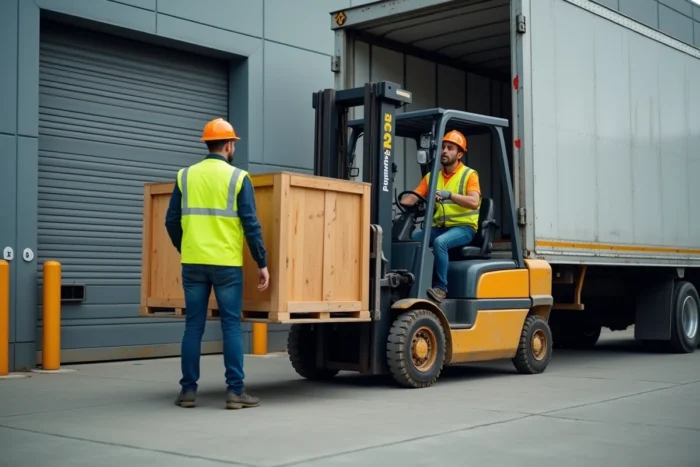
Some flatbed trucks are equipped with a hydraulic crane arm mounted at the front or rear of the chassis. This device allows loading and unloading of goods without relying on a lifting machine at the destination site.
The advantage is twofold. The transporter gains autonomy: no need to coordinate the intervention of an external crane operator, which reduces delivery times and eliminates a cost item. The construction site or receiving factory does not need to mobilize its own handling equipment.
The onboard crane has its limits. Its lifting capacity decreases with the reach of the arm. The further the load is from the truck’s axis, the less mass the arm can lift. The driver must know the load charts of their equipment to avoid any risk of tipping. Lifting operations on public roads are also subject to signaling and safety perimeter rules.
- Front crane: better visibility for the driver during loading, but reduces the usable length of the flatbed
- Rear crane: preserves loading length, more suitable for unloading on-site at the end of the flatbed
- Lifting capacity varies according to reach: always check the load charts before each operation
Regulations and tachograph: what changes for flatbed fleets
Flatbed trucks are subject to the same regulatory obligations as other freight transport trucks: compliance with the maximum authorized weight, periodic technical inspections, ongoing driver training (FCO). Securing is subject to specific roadside checks, with penalties for insufficient or non-compliant devices.
A regulatory change directly affects fleets using small flatbeds for cross-border trips. Starting July 1, 2026, utility vehicles over 2.5 tons engaged in international transport must be equipped with a next-generation smart tachograph. This requirement, which already applied to trucks over 3.5 tons, now extends to lighter vehicles used in cabotage or international transport.
Fleet managers must anticipate the cost of installation and updating tools for tracking driving and rest times.
The flatbed remains the most versatile type of bodywork for goods that vans and tautliners cannot handle. The choice between truck and semi-trailer, between open and tarped flatbed, between integrated crane and external handling, is made for each mission based on volume, weight, and access conditions at the delivery point.