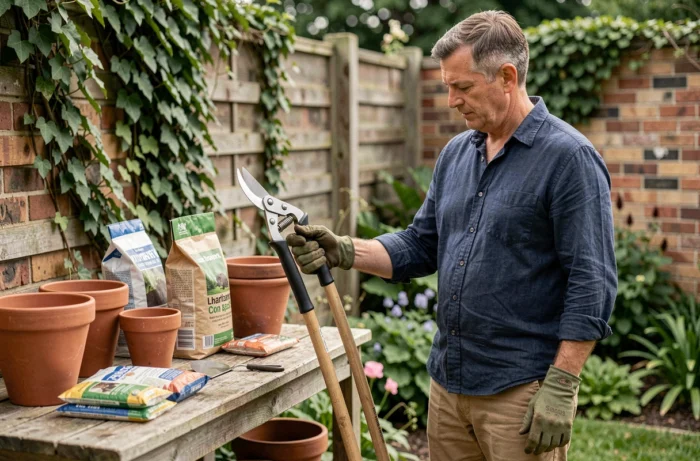
A plot of 800 m² with a hedge of privet, three fruit trees, and a sloping bank: you don’t choose the same tools as for a balcony with planters. The selection of efficient gardening tools always starts from the actual configuration of the land and the tasks that recur every week or season.
The French gardening tools market has been contracting since 2024, and households are renewing their equipment less frequently. It is therefore better to make methodical choices rather than accumulating underused equipment.
Interchangeable battery: the criterion that changes the purchasing logic
Before comparing lawn mowers or hedge trimmers model by model, it saves time to think in terms of battery ecosystems. Major brands (and discount retailers) now offer ranges where the same battery powers all the tools in the series. Parkside at Lidl, Worx’s PowerShare platform, or the 18 V and 36 V systems from professional brands operate on this principle.
The benefits are twofold. First, it reduces the overall cost: buying a second or third tool in “bare tool” version (without battery or charger) is significantly cheaper. Then, it limits clutter and the number of chargers lying around in the garden shed.
For those starting out with equipment, the choice of the battery platform matters more than the choice of the first tool. You can consult Mister House for gardening to compare feedback on several ranges before committing to an ecosystem.
One point to check: the voltage and amp-hour (Ah) capacity of the battery. A low-capacity battery will suffice for a string trimmer used for ten minutes, but it will struggle to last on a lawn mower for half an hour of continuous mowing. Starting with a minimum 4 Ah battery for power-hungry tools avoids unpleasant surprises.

Pruning and trimming tools: adapting the blade to the diameter of branches
Hedges are often massacred by a hedge trimmer that is too light or branches torn off by an undersized pruner. The choice of cutting tool depends on a simple parameter: the diameter of the branches to be treated.
- Up to 25 mm in diameter, a hand pruner (bypass for green wood, anvil for dry wood) is sufficient and provides a clean cut that heals quickly.
- Between 25 and 45 mm, a long-handled lopper or a power pruner provides the necessary leverage without straining the wrists.
- Beyond 45 mm, you switch to a pruning saw or chainsaw. For high branches, a pole tool avoids the use of a ladder, reducing the risk of falling.
The hedge trimmer, on the other hand, is chosen based on the cutting length and the spacing of the teeth. A wide tooth spacing is suitable for country hedges with thick branches, while a narrow spacing produces a neater finish on boxwood or laurel hedges.
For battery models, feedback varies on actual autonomy under dense trimming conditions. It is recommended to have a spare battery if the hedge exceeds about fifteen linear meters.
Lawn mower and brush cutter: choose according to the terrain’s topography
The lawn mower remains the most used tool in a garden with grass, but the type of mower directly depends on the terrain’s relief. On flat and open land, a self-propelled or conventional push battery mower does the job. On sloping or fragmented terrain with flower beds, a compact and lightweight mower, maneuverable in tight turns, will be more effective than a large model that is difficult to handle.
The brush cutter takes over where the mower cannot go: fence posts, slopes, wall edges. Rather than viewing the brush cutter as a secondary purchase, it can be considered the primary tool for rough terrain or poorly maintained plots.
A point often overlooked: regulations on the hours of use for powered tools. Municipal or prefectural orders regulate the authorized time slots for mowing and brush cutting, with possible fines for violations. Checking the order from your municipality before investing in noisy equipment allows you to anticipate any constraints on usage times.
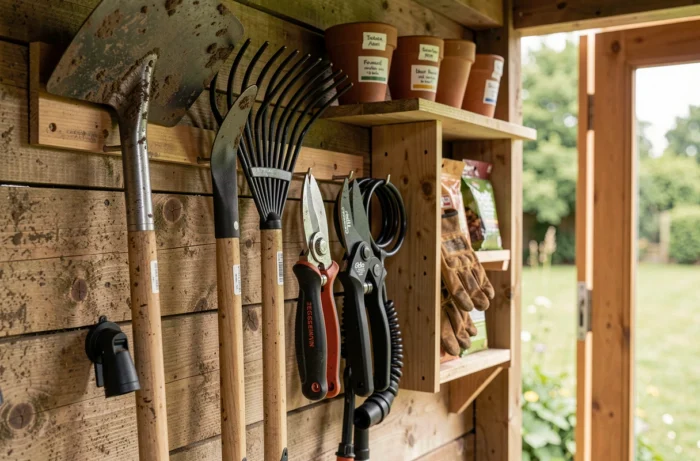
Maintenance of gardening tools: protecting the investment over time
In a context where households buy new equipment less frequently, extending the lifespan of each tool becomes a cost-effective reflex. Three actions make a difference.
Clean the blades after each use. Sap and moisture accelerate oxidation. A cloth soaked in denatured alcohol on the blades of the pruner or hedge trimmer takes thirty seconds and limits the spread of diseases from one plant to another.
Sharpen the blades at least once per season. A dull pruner crushes the branch instead of cutting it, which damages the plant and tires the hand. A flat file or diamond sharpener is sufficient for manual tools.
Store batteries in a dry place at room temperature. Lithium-ion batteries lose capacity if left discharged for several months or exposed to frost. Storing the charged battery between 40 and 80% in winter significantly extends its lifespan.
Before replacing a faulty tool, check if the malfunction concerns a wear part (blade, cutting line, filter) rather than the motor or battery pack. Repairs often cost a fraction of the price of a new tool, and more and more retailers offer compatible spare parts.
Choosing your gardening tools based on the terrain, the battery ecosystem, and the actual diameter of the branches to be cut avoids unnecessary purchases. The rest is regular maintenance and common sense regarding storage. A reduced but well-suited set of equipment will always perform cleaner work than a garage full of unsuitable tools.