
A pole saw is a lightweight chainsaw designed to cut branches at height or in hard-to-reach areas, where a traditional chainsaw would be too heavy or dangerous. Choosing the right model depends on three technical parameters: the type of motorization, the length of the guide bar, and the format of the tool (traditional or pole-mounted).
Motorization of the pole saw: gas, battery, or corded
The motorization determines both the cutting power, autonomy, and user comfort. Each technology caters to a different garden profile and level of requirement.
A gas pole saw operates with a gasoline engine. It offers high power and unlimited autonomy as long as the tank is full. This type of machine is suitable for large areas or thick branches, but it generates noise, vibrations, and requires regular engine maintenance (spark plug, filter, carburetor).
The battery pole saw has been improving over the past few years. Brushless motors reduce vibrations and extend the machine’s lifespan. The weight remains manageable, making prolonged work at height easier. The main limitation is autonomy, which is linked to the battery capacity. For regular domestic use, a detailed comparison on elagueuse-warrior.com helps identify models suitable for every budget.
The corded pole saw, plugged into an outlet, provides constant power without autonomy constraints. Its range depends on the length of the extension cord, which limits it to modest-sized gardens close to a power outlet.

Guide bar and cutting capacity: adapting the tool to the branches
The guide bar is the metal bar on which the cutting chain runs. Its length directly determines the maximum diameter of branches that the pole saw can cut.
For regular garden maintenance (dead branches, pruning fruit trees, ornamental trees), a guide of about twenty centimeters is sufficient in most cases. Beyond that, longer guides are reserved for heavier work or experienced users.
The chain itself deserves attention. A well-sharpened chain reduces the motor’s effort and limits the risk of kickback. Checking the chain tension before each use is part of basic safety practices. Some recent models include a tool-less tensioning system, which simplifies this operation.
Chain pitch and gauge
The pitch of the chain (distance between links) and the gauge (thickness of the drive link) must match the guide and the motor sprocket. A mismatch causes premature wear and degrades cutting quality. When replacing, it is essential to refer to the manufacturer’s exact specifications.
Traditional pole saw or pole-mounted saw: two distinct uses
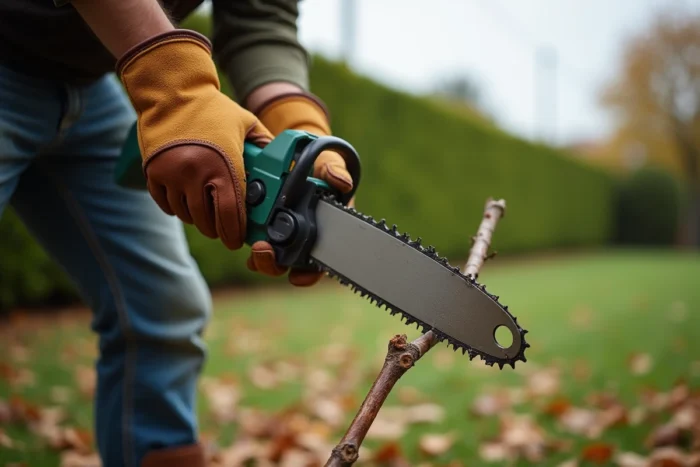
The traditional pole saw is held with both hands, like a small chainsaw. It is maneuverable, lightweight, and precise for shoulder-height cuts or from a ladder. Professionals often use it in conjunction with a harness to work in the crown of a tree.
The pole-mounted saw adds a telescopic tube between the motor and the cutting head. It allows reaching branches several meters high without leaving the ground. This is the safest option for individuals who do not wish to climb.
- The traditional pole saw is suitable for precision pruning, clean cuts on accessible branches, and work in trees with appropriate equipment.
- The pole-mounted saw targets maintenance at height from the ground, pruning high branches on isolated trees or property edges.
- Some multifunction models accept interchangeable heads (hedge trimmer, brush cutter), which makes the investment worthwhile for versatile garden use.
The total weight of the machine, including the pole, often exceeds that of a traditional pole saw by several kilograms. Working with raised arms using a heavy tool quickly fatigues the shoulders and back. Testing the weight in real conditions before purchase avoids unpleasant surprises.
Safety and maintenance: key points not to neglect
A pole saw remains a fast and powerful cutting tool. Some equipment and reflexes ensure safe use without accidents.
- The chain brake, triggered by the front hand guard, stops the chain in a fraction of a second in case of kickback. Its presence is a non-negotiable criterion.
- The anti-vibration system protects hands and joints during prolonged sessions. Battery models with brushless motors generally present lower vibration levels than gas models.
- Personal protective equipment (cut-resistant gloves, goggles, noise-canceling helmet for gas models) enhances user safety.
Regular maintenance of the chain and guide
After each use, cleaning the guide groove and checking the condition of the chain teeth prolongs the lifespan of the entire tool. A dull chain forces the motor and increases the risk of kickback. Sharpening can be done with a round file, respecting the angle recommended by the manufacturer.
For gas pole saws, draining the tank before prolonged storage prevents carburetor clogging. For battery models, removing the battery and storing it at room temperature preserves its capacity over the long term.
Battery mini-chainsaw: an alternative for small gardens
Battery mini-chainsaws, equipped with a short guide, have become widely popular. Their compact format and reduced weight make them accessible to users unfamiliar with powered equipment.
These machines cover occasional maintenance needs: pruning thin branches, light cutting after a storm, cleaning low-stem fruit trees. They do not replace a traditional pole saw for thick branches, but they are more than sufficient for an urban garden or a small plot.
Their complete kit (battery, charger, spare chain) and low vibration levels make them a reassuring first tool for starting tree maintenance without a heavy investment.
The final choice always depends on the size of the garden, the average diameter of the branches to be cut, and the frequency of use. A battery pole-mounted model covers most domestic needs, while a traditional gas pole saw remains the reference for large areas or regular cuts on hardwood.