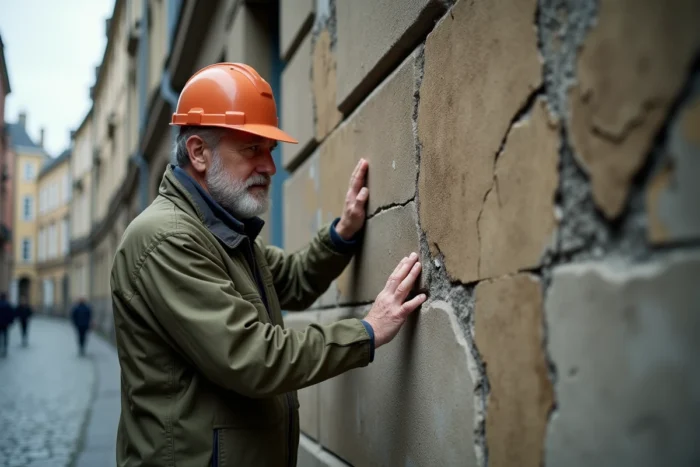
After several months of rain, frost, and successive thaws, the exterior walls of a house endure mechanical stresses that are often underestimated. Detecting facade damage after a wet winter does not require sophisticated equipment, but rather a careful eye focused on the right places at the right time. Waiting for the paint to peel or for moisture to penetrate the interior wall is just letting the bill rise.
Freeze-thaw cycle and porosity: what really weakens an exterior wall
Have you ever noticed that a concrete sidewalk cracks more after a harsh winter? The same phenomenon affects your facade. Rainwater penetrates the micro-pores of the plaster or brick, then freezes when the temperature drops below zero. As it freezes, it expands and exerts pressure from the inside out.
During thawing, the material contracts without returning exactly to its original shape. Repeated dozens of times between November and March, this freeze-thaw cycle gradually widens each micro-crack. North or northwest-facing facades, which remain damp longer and are less dried by the sun, experience this stress more acutely.
A plaster that appeared sound in October can thus show delaminations in spring, without any external shock being the cause. If you are considering bringing in a facade and waterproofing company, the post-winter diagnostic is the most relevant time to assess the true extent of the damage.
Visual inspection of the facade: three areas to examine as a priority
There’s no need to scrutinize every square inch. Facade damage after a wet winter almost always concentrates in the same places. Here are the three areas that deserve your attention first.
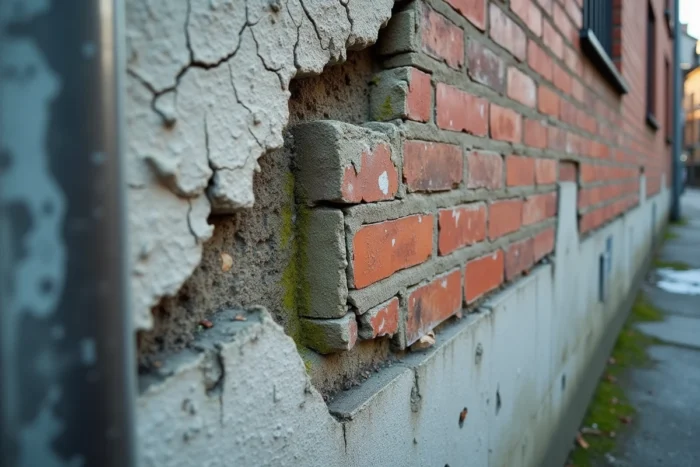
- The perimeters of windows and doors: the joints between the frame and the wall are the first to give way. Look for micro-cracks, a joint that is peeling, or plaster that sounds hollow when you tap it with the back of your hand.
- The base (bottom of the wall, in the first 30 to 50 centimeters): this is the area that receives capillary rises and rain splashes. Whitish marks (efflorescence of mineral salts) indicate a recurring migration of water through the wall.
- The corners and junctions with the roof or gutters: a blocked or poorly connected gutter during winter causes concentrated runoff that can degrade the plaster over a narrow vertical strip.
For each area, run your flat hand over the surface. Plaster that crumbles under slight pressure or forms small blisters indicates that water has already worked into the material deeply.
Facade cracks after winter: distinguishing superficial from structural
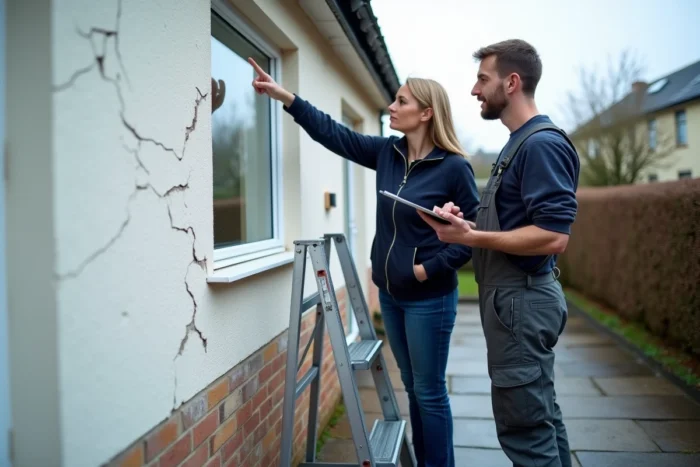
Not all cracks are created equal. A crazing, this network of fine cracks that resembles a spider web, usually remains superficial. It affects the finishing layer without compromising the wall’s waterproofing. In this case, a simple surface treatment is sufficient.
On the other hand, a crack wider than two millimeters that follows a linear path (horizontal, vertical, or stair-stepped along the masonry joints) may indicate structural movement. After a very rainy winter, waterlogged soil can cause differential settling of the foundations, especially on clayey ground.
How to tell the difference without being an expert? Place a simple witness: stick a piece of tape across the crack, date it, and check after three weeks. If the tape tears, the crack is active and requires a professional diagnosis. If the tape remains intact, the crack is likely stabilized and a suitable filling will be sufficient.
Moisture on interior walls: when the facade is already compromised
Sometimes, the first visible sign does not appear outside but inside. Stains on an interior wall that faces outside, paint that bubbles in a corner of the room, a persistent musty smell despite proper ventilation: all these clues point to infiltration through the facade.
Infiltration moisture is distinguished from condensation by its location. Condensation affects cold surfaces diffusely (windows, thermal bridges). Infiltration, on the other hand, creates a localized stain that enlarges during rainy episodes and decreases in dry weather, without ever completely disappearing.
An accessible test involves fixing a square of clear plastic film against the damp wall with tape on all four sides. After 48 hours, observe where droplets form. If they appear between the wall and the film, the water is coming from inside the wall (infiltration). If they settle on the side exposed to the room, it is condensation.
Deadlines and obligations: do not confuse comfort with regulation
Postponing facade repairs is not just a risk for the building. For landlord owners, an excessively high humidity level in the housing can lead to a classification of uninhabitability and an obligation to carry out work. Regulations set a tolerance threshold of around ten percent humidity in materials for existing buildings.
In co-ownership, the property manager is responsible for having the renovation work voted on when the facade shows proven damage. If your municipality has issued a mandatory renovation order, the compliance deadline is regulated, and non-compliance can lead to financial penalties.
Another point rarely anticipated: since the beginning of 2026, external or internal wall insulation is no longer fundable in the “by gesture” pathway of MaPrimeRénov’. Combining a renovation with thermal insulation remains possible, but only as part of a comprehensive renovation. It is better to integrate this constraint right from the facade diagnosis to avoid financing two separate interventions.
Acting in spring, in the weeks following the end of frosts, remains the most favorable window. Plasters and water-repellent treatments require a dry substrate and stable positive temperatures to adhere properly. Delaying the intervention until autumn exposes the facade to a second winter with the same weaknesses, and often aggravated damage.