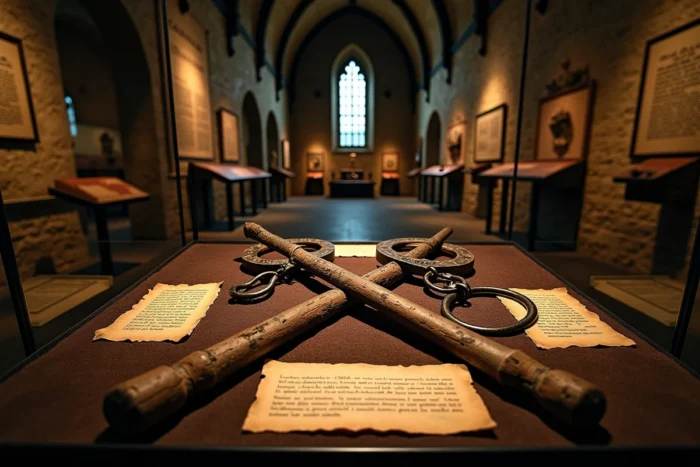
When examining the judicial archives of the medieval principalities of Central Europe, one detail stands out: impalement does not appear as an act of spontaneous barbarism. It is clearly outlined in local penal codes, with specific criteria for its application. This legal reality changes the interpretation of impalement in the Middle Ages, which is part of a penal system shared by several regions.
The stake in medieval Germanic criminal law
Impalement is almost automatically associated with Vlad III Dracula and 15th century Wallachia. Recent historical research significantly nuances this shortcut. A study published in the Transactions of the Royal Historical Society in 2022 demonstrates that Vlad III partly borrowed this practice from the penal provisions of the Saxon towns in Transylvania.
The Altenberg Codex, a legal text inspired by Germanic law, explicitly provided for the stake as a punishment for specific crimes: infanticide, rape, murder of relatives, adultery. In some cases, both adulterous partners could be impaled on the same stake. This is far from the image of a tyrant inventing a torture out of personal sadism.
This legal framework explains why the punishment could be applied on a collective scale without provoking immediate revolt among local populations: it was, at least partially, part of a legal logic that contemporaries recognized. To delve deeper into the history of impalement in the Middle Ages, this legal dimension deserves to be taken into account before any purely sensational reading.

Collective impalement under Vlad III: are the figures reliable?
Popular accounts speak of tens of thousands of victims impaled by Vlad III Dracula. These spectacular figures have circulated for centuries and fuel the myth of the “impaler prince.” The 2022 study published in the Transactions of the Royal Historical Society offers a methodical reevaluation that challenges these estimates.
The main sources are propagandistic pamphlets, written by political opponents of Vlad, particularly in the Saxon towns of Transylvania with which he was in open conflict. These texts had a clear objective: to construct an image of absolute terror to discredit the Wallachian prince among European courts.
The cross-referencing of narrative texts with the demographic and military context of the time allows for a reevaluation of these figures. The actual number of victims remains difficult to establish, but the gap between propaganda and documentable reality seems considerable. This deconstruction work relies on a confrontation of narrative, demographic, and military sources that significantly alters the usual scales of magnitude presented.
Propaganda and the construction of the Dracula myth
The German pamphlets of the 15th century describing Vlad’s atrocities are among the first widely circulated printed texts in Europe. Their editorial success has solidified an image that has traversed the centuries without critical filter. The myth preceded historical analysis by several hundred years.
This mechanism of horror propaganda was not unique to Vlad. Similar processes can be found in accounts of the Crusades or in chronicles of the Hussite wars, where the enemy is systematically depicted as a monster to justify the violence inflicted upon them.
Impalement in the Middle Ages: execution technique and regional variations
On the ground, impalement was not practiced in a single manner. Historical and archaeological sources describe several variants that depended on the region, the time period, and the executioner’s intent.
- Longitudinal impalement, where the stake passed through the body from bottom to top, was designed to prolong agony for several hours, sometimes several days. The stake was carefully rounded to avoid piercing vital organs too quickly.
- Transversal impalement, through the abdomen or flank, caused a quicker death and served more as execution than prolonged torture.
- Post-mortem impalement also existed: the bodies of already dead combatants were impaled on stakes placed along roads or at city gates to create a deterrent effect on enemy armies.
The spectacular dimension of the punishment was as important as the suffering inflicted. Arranging impaled bodies in rows visible from main roads constituted a political message directed at military adversaries and potentially rebellious populations.
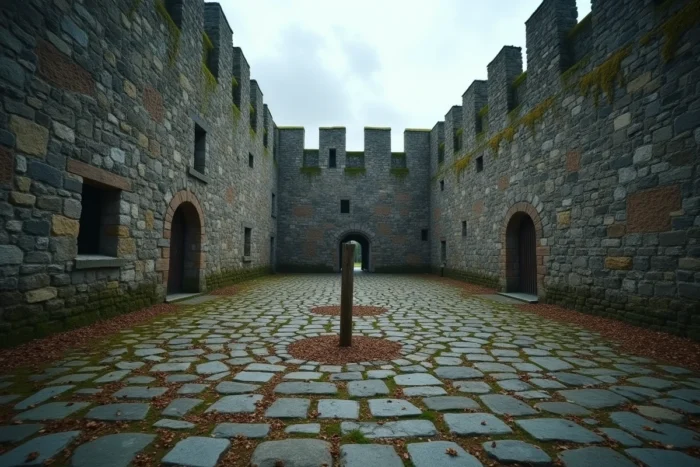
Impalement outside medieval Europe: a shared punishment
Reducing impalement to medieval Europe would be inaccurate. This practice appears in the Ottoman Empire, in ancient Assyria, in pharaonic Egypt, and in several kingdoms of Southeast Asia. The Code of Hammurabi already mentions impalement as punishment for certain forms of treason.
In the Middle Ages, the Ottoman Empire used the stake as a tool of military terror on a large scale during its campaigns in the Balkans. Byzantine chroniclers and Western travelers report detailed descriptions that contributed to fueling the fear of the “Turkish invader” in Western Europe.
From the 12th century onward, several medieval jurisdictions attempted to frame impalement with legal criteria, while ancient empires practiced it primarily as a demonstration of brute power. The case of the Altenberg Codex mentioned earlier illustrates this trend to embed the punishment within a normative framework.
Gradual disappearance of the punishment in Europe
Impalement declined in Western Europe from the 13th century, replaced by other forms of public execution deemed more “acceptable” by religious and civil authorities. In Central and Eastern Europe, the practice persisted longer, particularly in the border regions of the Ottoman Empire where military violence remained intense.
The disappearance of the stake was not dictated by a linear moral progress but by practical evolutions: centralization of judicial power, growing influence of the Church on execution methods, and adoption of methods perceived as quicker. The breaking wheel or hanging took over, and the severity of capital punishment in Europe only gradually decreased from the late 18th century onward.