
White vinegar, with an acetic acid concentration between 5 and 14% depending on commercial products, acts as a contact desiccant on leaves. When applied to a plant, it destroys the waxy cuticle that protects plant tissues, causing rapid drying of the aerial parts. On a lawn, this property poses an immediate problem: acetic acid makes no distinction between a weed and a blade of grass.
Many sites present vinegar as an ecological alternative to synthetic herbicides. The agronomic and regulatory reality is more nuanced, and several recent elements deserve to be detailed before reaching for the sprayer.
Acetic Acid and Plants: A Contact Herbicide, Not a Systemic Herbicide
The most common confusion concerns the mode of action of vinegar. A systemic herbicide (like glyphosate) is absorbed by the plant and circulates to the roots, destroying the entire root system. Acetic acid, on the other hand, only burns the tissues it directly touches.
In practical terms, the exposed leaves turn yellow and dry out within a few hours. The roots remain intact underground. A perennial weed like dandelion or couch grass will therefore regrow after a few days, sometimes with more vigor as the plant mobilizes its root reserves to replenish its foliage.
To assess the effectiveness of vinegar on the lawn, it is necessary to distinguish between two cases: annual weeds (such as chickweed and starwort), whose shallow root system can be weakened by repeated applications, and perennials with taproots or rhizomes, on which the result remains temporary and cosmetic.
Effect of Vinegar on Soil and Lawn Fertility
Popular articles focus on the visible yellowing of leaves. The underground impact is less spectacular but more lasting.
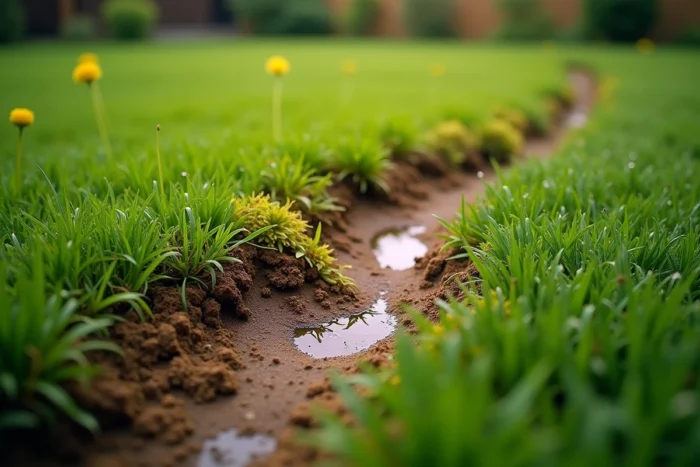
Acetic acid acidifies the soil at the point of application. A one-time use on a gravel path has no measurable consequence. On a lawn, repeated applications in the same area can lower the local pH below the comfort threshold for grasses (around 6 to 7 depending on the species).
Soil acidification has several chain effects:
- It disrupts the activity of microorganisms that decompose organic matter and release nutrients that can be absorbed by the grass roots.
- It can reduce the population of earthworms in the treated area, limiting the natural aeration of the soil.
- Paradoxically, it promotes certain acidophilic weeds (like moss) that the treatment aimed to eliminate.
This vicious circle explains why some gardeners notice a resurgence of moss after treating their lawn with vinegar for several seasons. The remedy exacerbates the problem it claims to solve.
White Vinegar and Regulation: A Phytopharmaceutical Product Without Authorization
This point remains largely unknown. Since 2019, ANSES considers that any product used to destroy unwanted plants falls into the category of phytopharmaceutical products. This qualification applies regardless of the ingredient, including household vinegar, as long as it is used as a herbicide.
White vinegar does not have any Marketing Authorization (MA) for “weeding” use. Its use for this purpose is therefore legally equivalent to the use of an unapproved pesticide. Legal outreach sources mention a risk of fines up to 1,500 euros for individuals.
This regulation also applies to homemade mixtures (vinegar, salt, dish soap) that are frequently shared on social media. The addition of salt actually worsens the agronomic situation: sodium chloride sterilizes the soil permanently and makes the regrowth of grass much more difficult than vinegar alone.
Concrete Alternatives for Weeding a Lawn Without Vinegar
Rather than resorting to a product that damages the lawn as much as the weeds, several approaches target weeds without degrading the lawn.
Densifying the Lawn to Smother Weeds
A dense and well-nourished lawn leaves little room for weeds. Overseeding in spring or early autumn, combined with the application of organic fertilizer, strengthens the plant cover. Mowing at an appropriate height (not too short) deprives weeds of light without stressing the grasses.
Targeted Mechanical Weeding
Hand pulling remains the most selective method. A weeding knife allows for the extraction of dandelions with their taproot, something vinegar never does. For larger areas, annual scarification removes moss and thatch, two factors that favor the establishment of unwanted plants.
Correcting Soil pH Rather Than Acidifying It
If moss is proliferating, it is often a sign of already acidic, compacted, or poorly drained soil. A light liming (application of lime or dolomite) corrects the pH and creates unfavorable conditions for mosses. Mechanical aeration of the soil improves drainage and promotes deep rooting of the grass.
Vinegar on the lawn makes the leaves of weeds disappear for a few days, but the roots persist, the soil acidifies, and the lawn weakens with each application. A well-maintained lawn itself constitutes the best weed killer, occupying the space and resources that weeds covet.
Working on soil fertility and the density of plant cover yields slower but more lasting results, without regulatory risk or degradation of the land.