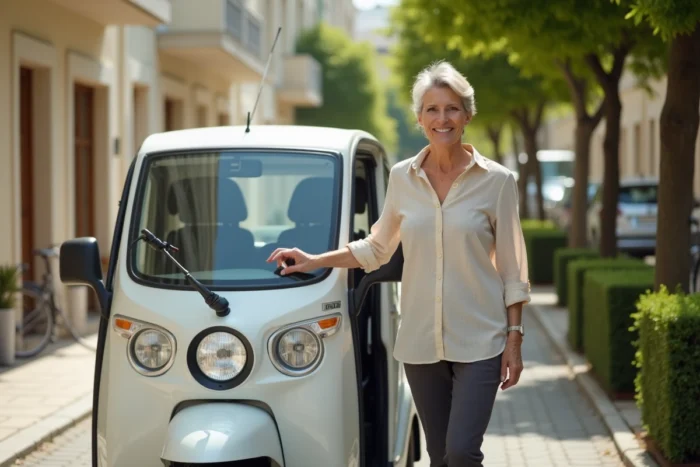
A light motor quadricycle, limited to 45 km/h and accessible from the age of 14 with an AM license, is legally classified in the L6e category. This technical definition alone explains a significant part of the growing appeal of the license-free car: the vehicle escapes the constraints of the B license while offering a closed cabin, a trunk, and two seats.
The electric shift in the market for license-free cars in France
Content discussing the success of small cars often mentions electrification, but rarely its recent scale. In France, the share of electric license-free vehicles (VSP) rose from about 52% of sales in 2024 to 75% in 2025. Thermal models now represent only a quarter of the segment.
This shift occurred without specific public aid: light quadricycles were excluded from incentives for purchasing electric vehicles. Demand therefore relies on the appeal of the product itself, which the firm Jato Advisory confirms in its market analyses.
Three factors fuel this preference for electric in this segment:
- The quiet operation and absence of exhaust emissions meet the expectations of urban drivers seeking mobility perceived as clean, without investing in a traditional electric city car.
- The cost of charging remains marginal compared to diesel, especially for short daily trips (home-work, shopping, school drop-offs).
- The mechanical simplicity of an electric motor reduces maintenance interventions compared to a small diesel, reassuring non-mechanic profiles.
As detailed in the license-free car on Autoscope, this electric dynamic is reshaping the typical profile of the small car buyer.
License-free car and urban mobility: a vehicle designed for the city
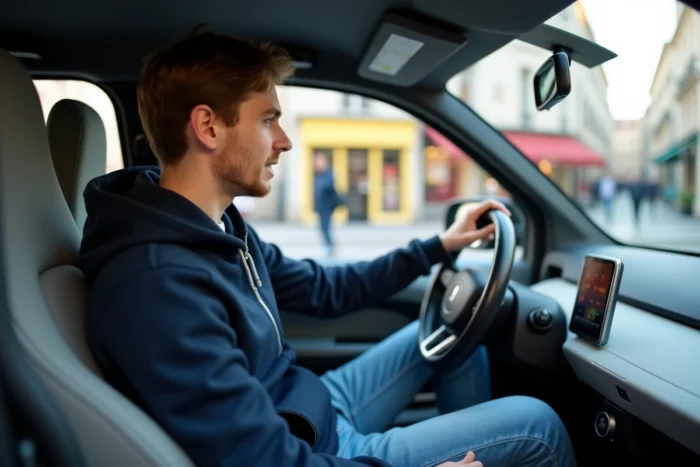
The L6e category imposes a maximum speed of 45 km/h. On a ring road or a national road, this is a disadvantage. In the city, it is a non-issue: the average traffic speed in major French urban areas rarely exceeds 20 km/h during peak hours.
The reduced size of the light quadricycle turns parking into a concrete advantage. Where a traditional city car struggles to park in certain dense neighborhoods, the VSP can squeeze into spaces inaccessible to standard cars.
Low-emission zones (ZFE), which are multiplying in France and gradually restricting access for older thermal vehicles, enhance the interest in electric license-free models. An electric quadricycle is not subject to restrictive Crit’Air stickers, ensuring permanent access to regulated city centers.
Who buys a VSP: the changing customer base
The image of the small car has long been associated with two profiles: drivers who have lost their license and elderly people in rural areas. This stereotype no longer reflects the reality of the market.
Young people aged 14 to 17 now represent a visible share of the customer base. The cost of the B license (often exceeding 1,500 euros in traditional driving schools) and the time required to obtain it push some families to opt for a quadricycle accessible with just the AM license, obtained in a few days.
Urban workers constitute another growing segment. For home-to-work trips under 15 km, the electric VSP offers a very low usage cost: no license to finance, insurance generally lower than for a city car, and modest electricity consumption.
The range effect of manufacturers
Aixam, Ligier, and Citroën (with the Ami) have evolved the design and equipment of their models. Connected screens, refined upholstery, colorful finishes: the VSP has come closer to the aesthetic codes of traditional city cars. This repositioning has helped attract buyers who would not have considered a small car five years ago.
Real cost of a license-free car: beyond the purchase price
The catalog price of a new VSP often surprises: some models exceed 15,000 euros, a price comparable to that of a small city car with a license. This price is explained by low production volumes (niche market), specific components (chassis, L6e homologation), and predominantly European manufacturing.
The relevant calculation focuses on the total cost of ownership, not just the purchase price. Here are the items to compare with a traditional city car:
- Insurance: the annual premium for a light quadricycle is generally lower than that of a category B car, especially for a young driver.
- Maintenance: an electric motor without a clutch, complex gearbox, and periodic oil changes reduces maintenance costs.
- Energy: home charging of a small capacity battery costs a few cents per trip, well below a full tank of diesel or gasoline.
- Parking: in some municipalities, quadricycles benefit from preferential rates or dedicated spaces.
Over three to five years of daily use in the city, the overall cost gap between an electric VSP and a thermal city car narrows significantly, or even reverses for profiles that combine short trips and paid parking.
Regulation and the future of light quadricycles in Europe
The strengthening of ZFEs and the upward trend in fuel prices solidify the positioning of the electric VSP as a sustainable urban mobility solution. The segment is no longer a substitute market for drivers without alternatives: it is becoming a deliberate choice for motorists who prioritize simplicity and usage cost.
The market for license-free cars remains small compared to that of traditional automobiles, but its rapid growth and shift towards electric signal a structural change. The next variable to watch will be the impact of new entrants on prices and the response of historical European manufacturers.