Organizing children’s puzzles is akin to solving a domestic logistics problem: pieces of varying sizes, bulky boxes, and a constant risk of mixing. This article compares ten puzzle storage solutions for children based on three concrete criteria: the protection of pieces, space-saving, and the autonomy they offer to the child on a daily basis.
1. Transparent storage boxes
Transparent boxes with clip-on lids allow you to see the contents without opening them. They come in stackable formats, which minimizes the footprint in a play corner or on a shelf.
Their main advantage is the immediate visual control of the contents: the child can identify the puzzle they are looking for without emptying three bins. Attaching a photo of the completed model on the lid further speeds up the identification.
A limitation to consider: for large puzzles, the size of the box increases quickly. It’s better to reserve this system for puzzles with fewer than one hundred pieces, which are easier to package. For other complementary approaches, you can see the tips on Astuces Parents that detail several variants suitable for small spaces.
2. Airtight pouches
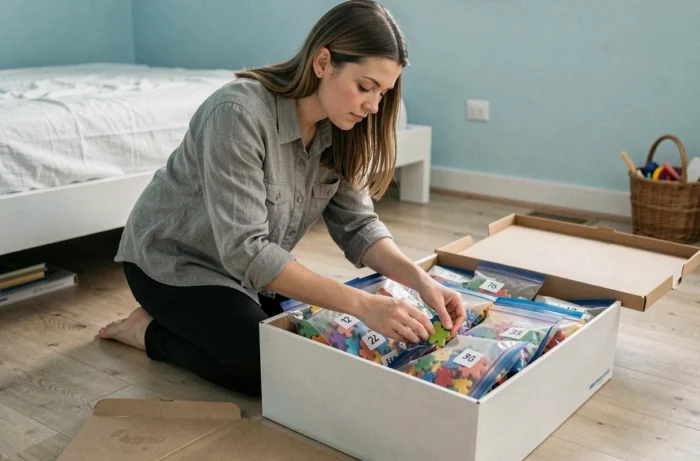
Transparent zippered pouches (like reinforced freezer bags or resealable zip pouches) are the most economical solution. They replace the original boxes, which are often oversized, and can be slipped into a drawer or bin.
The space-saving is significant compared to cardboard boxes. By inserting the photo of the completed puzzle into the pouch, identification remains simple. The pouches are well-suited for puzzles with up to fifty pieces.
They offer less protection against crushing than a rigid container. For thick wooden puzzles, prefer another support.
3. Modular drawers
A piece of furniture with shallow drawers, like a low dresser or modular block, allows puzzles to be stored flat. Each drawer accommodates an ongoing or completed puzzle without excessive stacking.
This system is particularly suitable for puzzles in progress: the child pulls out the drawer, picks up where they left off, and then closes it. Access is independent if the furniture is at their height. The stability of the furniture is a real safety issue: recent recommendations suggest securing any furniture that may tip over to the wall, especially in a young child’s room.
4. Dedicated shelves
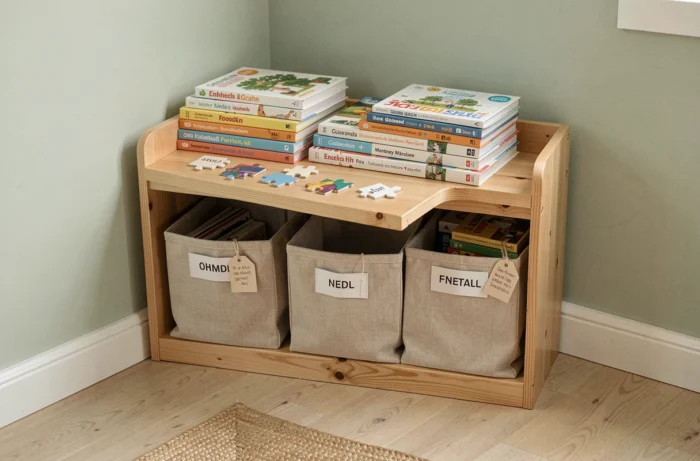
A low open shelf, inspired by Montessori-style setups, displays puzzles vertically or flat. The child sees the entire collection and chooses freely.
This storage promotes autonomy and regular rotation of accessible puzzles. A study on toddlers faced with a limited choice of toys showed that a restricted number of options encouraged longer and more varied play. Applying this principle to puzzles means displaying a few models and storing the rest elsewhere.
Tall shelves should be secured to the wall. Puzzles with small pieces should be placed out of reach of very young children.
5. Compartment binders
A binder with plastic sleeves, like those used for storing A4 documents, can hold flat puzzle pieces. Each compartment corresponds to a puzzle, identified by a label or a photo slipped into the cover.
This method is especially suitable for thin puzzles with a low number of pieces (educational puzzles, insertions). It can be stored upright on a shelf like a book, freeing up horizontal space.
6. Rolling bins
Rolling bins can slide under a bed or a coffee table. They offer significant storage volume while remaining accessible to children.
Their mobility facilitates storage: the child pulls out the bin, places the pieces inside, and then pushes it back. To avoid mixing between multiple puzzles, combining the rolling bin with airtight pouches inside works well. Avoid heavy lids for bins intended for young children to reduce the risk of pinching.
7. Cataloging sheets
Keeping a paper or digital inventory of each puzzle (number of pieces, theme, condition) may seem excessive, but it proves useful once a family accumulates more than a dozen models. A sheet per puzzle notes:
- The theoretical number of pieces and the date of the last count
- The theme and estimated level of difficulty
- The storage location (shelf, bin, drawer)
This system allows for quick identification of an incomplete puzzle before offering it to the child. Recent recommendations on toy rotation suggest removing games with missing pieces rather than leaving them in circulation.
8. Separation by difficulty level
Grouping puzzles by difficulty level (number of pieces, type of insertion) simplifies the choice for both the child and the accompanying adult. A simple code is sufficient:
| Level | Type of puzzle | Recommended storage |
|---|---|---|
| Easy | Insertions, fewer than 20 pieces | Low shelf, free access |
| Intermediate | 20 to 60 pieces | Pouches or boxes, independent access |
| Advanced | More than 60 pieces, thin pieces | Drawer or bin, supervised access for younger children |
Placing puzzles with small pieces up high or out of reach of toddlers meets both safety and organizational criteria.
9. Vacuum storage bags
Vacuum bags, typically used for clothing or bedding, compress the volume of a completed or loose puzzle. The space-saving is maximal for long-term storage (seasonal puzzles, puzzles that the child has outgrown).
Two limitations: handling is not independent for a child and thin cardboard pieces may warp under prolonged pressure. Reserve this method for puzzles that are only taken out occasionally.
10. Labeling and color coding
Assigning a color to each puzzle (sticker, felt tip dot, or colored tape) on the pieces and the container allows for quick sorting of an accidental mix. A child who cannot yet read can identify the color without help.
This system can be combined with all other solutions. It turns storage into a sorting activity, extending playtime while developing concentration. A colored dot on the back of each piece is sufficient to prevent mixing between puzzles stored together.
The choice between these ten methods depends on the number of puzzles, the child’s age, and the available space. Combining two or three solutions (pouches in a rolling bin, color labeling on a dedicated shelf) covers most situations without multiplying storage materials.