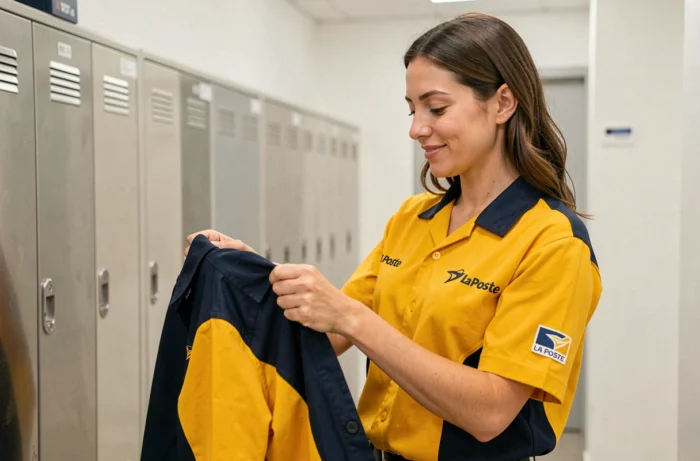
We arrive at La Poste, the contract is signed, the manager hands over a badge, and the first practical question arises: where to pick up the work uniform? The portal monespacehabillement.laposte.fr is the official answer. It is an ordering platform reserved for agents, where each item (polo, parka, safety shoes) is paid for in allocation points, not in euros. For a new hire, the logic of the catalog and the balance of points is not obvious in the first few days.
Initial allocation and point credit for new La Poste agents
When the account is activated after validation by HR, a balance of points appears at the top of the interface. This credit constitutes the envelope with which one composes their professional wardrobe. Each item in the catalog consumes a portion of this balance.
The common trap is to deplete the allocation on the first visible items without consulting the entire catalog. One orders two polos and a jacket, then realizes there are not enough points left for the safety shoes, which are mandatory for certain distribution positions.
Before validating anything, browsing the entire catalog and listing the mandatory items according to one’s job avoids this mistake. A mail carrier does not have the same needs as a counter agent. Technical items (parkas, shoes) weigh heavily in points, while polos cost comparatively little.
As detailed on the La Poste clothing space on 2moiselles Happy Lookeuses, the strategy is to prioritize safety and seasonal equipment before comfort items.
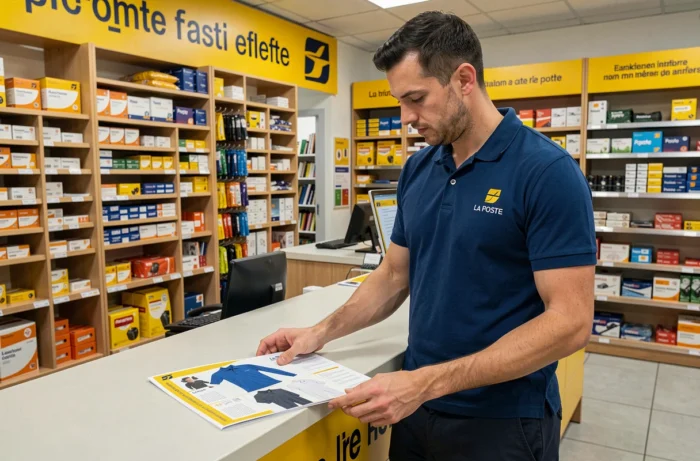
Login to monespacehabillement.laposte.fr: HR identifier and first access
Access is via the La Poste intranet or directly from monespacehabillement.laposte.fr. One uses their HR identifier, the same as for other internal services. The password is that of the employee account.
The account is not active from the first day of taking up the position. The management must validate the assignment and the profile must be created on the platform side. This delay varies by establishment. Some agents receive their access in a few days, while others wait several weeks.
If the connection fails, two quick checks to make:
- Confirm with the local HR service that the clothing profile has been created and linked to the correct job, as the job determines the accessible catalog.
- Test the connection from an internal La Poste workstation rather than from a personal device, as some firewalls block external access.
- Check that the employee account password has not expired, which blocks all internal services, not just the clothing space.
La Poste clothing campaign: ordering windows and catalog seasonality
The catalog is not open permanently. Orders are organized by campaigns, usually linked to the seasons. A spring-summer campaign offers short-sleeved polos and lightweight pants, while the autumn-winter campaign highlights parkas, fleeces, and warm accessories.
Missing a campaign means waiting for the next one to complete the allocation. For a new hire who arrived in October, not ordering their parka during the ongoing winter campaign can pose a real operational problem in the field, especially during distribution rounds.
The exact calendar of campaigns is not always communicated well in advance. It is usually found on the homepage of the portal once logged in, or via a service note distributed by the manager. Getting into the habit of checking the portal regularly after each login helps not to miss an opening.
Sizes and fitting: limiting unnecessary returns
The size guide available on the portal provides standard correspondences (S, M, L or numeric sizes). In the field, agents find that tops tend to fit snugly while technical pants offer a looser cut. After a few washes, some technical fabrics shrink slightly.
A return for the wrong size takes time and, depending on the periods, can delay the receipt of the correct item until the next campaign. When in doubt between two sizes, taking the larger size for tops remains the most shared advice among experienced agents.

End of use of La Poste professional clothing: return and circular economy
This aspect is recent and often overlooked by newcomers. La Poste now incorporates the management of its professional clothing into a circular economy approach. According to an article published by La Poste in September 2026, the recycling of uniforms is linked to economic activity integration, meaning that end-of-life clothing does not simply go to waste.
Specifically, the end-of-use guidelines (return, sorting, collection) may vary depending on the job and local management. Repair and refurbishment are also part of the system, not just material recycling. An agent returning a worn parka potentially contributes to a reuse stream.
For a new hire, remembering that professional clothing is not personal property clarifies the framework. They remain the property of the employer, and their return may be requested in case of departure or job change. Keeping old items without reporting them can pose an administrative problem during the renewal of allocation.
The La Poste clothing space remains a simple tool once one understands the mechanics of points, the rhythm of campaigns, and size constraints. The reflex to adopt from the first week: log in, identify the mandatory items for one’s position, and place an order before the end of the ongoing campaign. The rest adjusts with the experience of the first rounds or the first months in the office.