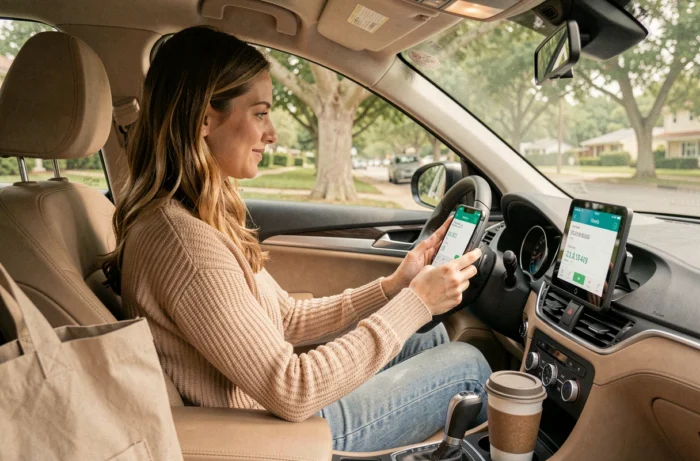
Carpooling is based on a simple principle: the driver shares the actual costs of the journey with passengers without making a profit. This legal framework distinguishes cost-sharing from paid transport services. The amounts received by the driver are not taxable as long as they do not exceed the costs incurred for the journey. Any amount above that may be reclassified as income by the tax authorities.
There are two ways to calculate a per-kilometre price. They do not produce the same result, and choosing one over the other changes how the costs are ultimately split between passengers.
Actual carpooling costs: the fuel and toll formula
The first approach is to add up the expenses directly related to the journey: fuel consumed and any motorway tolls. To estimate fuel costs, you need to know the vehicle’s average fuel consumption (in litres per 100 km), the distance travelled and the price per litre at the pump.
The formula is simple: (fuel consumption / 100) x distance x price per litre, plus any tolls. The total is then divided by the number of people in the vehicle, including the driver.
This method has the advantage of being transparent. Each passenger can check the figures. An online tool lets you calculate the cost of carpooling per kilometre by entering these details, avoiding rough estimates.
The drawback of this formula is that it ignores vehicle wear and tear, insurance and maintenance. The driver bears these fixed costs alone, creating an imbalance on regular journeys.

Applying the tax mileage allowance to carpooling
The second method uses the mileage allowance published each year by the tax authorities. This allowance covers not only fuel, but also vehicle wear and tear, insurance and maintenance. It varies according to the vehicle’s tax horsepower and the distance travelled annually.
For carpooling, the driver can use this allowance to estimate the total cost of the journey, then divide it by the number of people in the car. The amount per passenger is generally higher than with the fuel-only formula.
When is the mileage allowance relevant?
This calculation is most appropriate for regular commutes. Over the course of a year, fixed costs (insurance, servicing and tyres) make up a significant share of the actual cost per kilometre. Ignoring them means underestimating the contribution requested from passengers.
For a one-off journey of a few hundred kilometres, the difference between the two methods remains modest. For a daily journey of several dozen kilometres, the gap adds up and becomes significant for the driver.
Sharing costs between passengers: what about the driver?
One point that online calculators rarely cover in detail: should the driver pay their share or not? The answer changes how much each passenger is asked to pay.
- If the driver is included in the cost-sharing arrangement (4 people in the car, costs divided by 4), each passenger pays less, but the driver covers their own share as well as the wear and tear they alone incur.
- If the driver is excluded from the cost-sharing arrangement (costs divided among 3 passengers), passengers pay more, but the driver recoups all the variable costs.
- The most common practice on carpooling platforms is to include the driver in the cost-sharing arrangement, keeping prices low for passengers.
There is no legal rule that settles this question. It is an agreement between the people involved. For regular journeys, it is best to agree on the arrangement from the outset to avoid misunderstandings.

Cutting journey costs: what really makes a difference
Filling the car is the most direct way to save. Going from two to four occupants halves the cost for each person, with no extra effort. On a commute of several dozen kilometres, this can save each participant several hundred euros a year.
Vehicle fuel consumption and driving style
The second factor is the vehicle’s actual fuel consumption. Smooth driving (anticipating braking, maintaining a steady speed and keeping engine revs low) significantly reduces fuel consumption compared with aggressive driving.
The type of vehicle also matters. A diesel or hybrid vehicle has a lower cost per kilometre than a large-engine petrol model. Drivers of electric vehicles need to adjust the calculation: the cost of charging per kWh replaces the price per litre, and the cost per kilometre of an electric vehicle remains significantly lower than that of a combustion-engine vehicle.
Tolls and alternative routes
On long journeys, motorway tolls can account for a significant share of the total cost. Comparing the motorway route with one using main roads can sometimes reduce the overall bill, at the expense of a longer journey. It is worth comparing the options for each trip: on some routes, the toll savings more than offset the extra fuel consumption of a more winding route.
Carpooling and tax: where to draw the line
Money received through ordinary carpooling (sharing the costs of a journey the driver is making for their own purposes) does not need to be declared for tax purposes. This exemption applies provided the driver makes no profit and the journey is for personal or professional reasons and would have been made anyway.
If the amount received exceeds the actual costs, or if the driver arranges journeys solely to transport passengers, the tax authorities may consider it a commercial activity. The income then becomes taxable.
- Cost-sharing does not need to be declared as long as it strictly covers the costs of the journey.
- A driver who receives more than their actual costs risks having the income reclassified for tax purposes.
Calculating the cost per kilometre is therefore about more than just making things fair between carpoolers. It also acts as a safeguard against tax issues. A price based on actual costs protects the driver while ensuring passengers pay a fair rate.