
When moving in or renovating, the first reflex is often to list purchases room by room. The problem is that this approach overlooks the technical constraints that condition everything else: thermal regulations, compatibility between equipment, actual capacity of the electrical panel. Choosing the right equipment for your modern home starts with laying these foundations before thinking about visible comfort.
Carbon Constraint RE2020: What Guides Equipment Choices in New Homes
For any construction project submitted since 2022, the RE2020 regulation imposes carbon footprint ceilings over the entire lifecycle of materials and equipment. These thresholds become stricter in phases (2022-2024, 2025-2027, 2028-2030, and then after 2031). In practice, gas is ruled out as the main heating solution in new individual homes.
We are therefore directed towards heat pumps, predominantly renewable heat networks, or wood. This is not a comfort choice; it is a regulatory obligation that conditions the sizing of the entire installation: thermodynamic water heater, low-temperature underfloor heating, double-flow ventilation.
If you are renovating an older home, the RE2020 does not apply directly. However, financial aids for renovation favor the same types of low-carbon equipment, which often leads to the same decisions. To browse all the equipment offered on Maisons et Conseils, we see that this shift towards low-carbon options now structures the available ranges.
Size the Electrical Panel Before Choosing Your Devices
We regularly see homeowners buying a heat pump, a thermodynamic water heater, and an induction cooktop without checking the capacity of their electrical panel. The result: repeated tripping, the need to have the installation redone by an electrician, unexpected costs.
The electrical panel sets the upper limit for your equipment. Before any purchase, check the subscribed power, the number of available circuits, and the size of existing cables.
Points to Check Before Investing
- The power of the meter (in kVA): an air-water heat pump and an induction cooktop on the same circuit require a higher subscribed power than a standard gas-heated home.
- The number of free departures on the panel: each major appliance (heat pump, water heater, electric vehicle charging station) requires a dedicated circuit with its own circuit breaker.
- The compliance of grounding and differential: in an older home, renovating the panel is often a non-negotiable prerequisite before installing modern equipment.
This diagnosis costs little compared to a complete overhaul of the installation afterward. It is the first step, not the last.
Heating and Hot Water: Choose a Coherent System Rather Than Isolated Devices
The classic mistake in modern home equipment is to select each device separately (a radiator here, a water heater there) without considering the overall system. An air-water heat pump can produce heating and domestic hot water in a single circuit. A ductable pellet stove can heat several rooms without a radiator network.
Thinking in systems reduces the number of devices, maintenance, and consumption. It enhances thermal coherence and simplifies future interventions.
Heat Pump or Wood Stove: A Choice Dependent on the Structure
In a very well-insulated new construction (RE2020), heating needs are low. A reversible air-air heat pump is often sufficient for a modestly sized home. In a renovation with average insulation, a pellet stove coupled with supplementary electric radiators remains a coherent option.
Feedback varies on this point: some homeowners in new homes find the air-water heat pump oversized for their actual needs, while others appreciate the comfort of the underfloor heating it supplies. The decision depends on the volume to be heated, the climatic zone, and the installation budget.
Kitchen and Bathroom Equipment: Prioritize Faucets and Ventilation
The kitchen and bathroom concentrate the majority of water points and sources of humidity in a home. Before choosing a countertop or vanity unit, ensure that the mechanical ventilation and faucets are at the right level.
A thermostatic mixer in the bathroom significantly reduces hot water waste compared to a standard mixer. In the kitchen, a faucet with an integrated flow limiter provides the same comfort of use with reduced consumption.

Single or Double Flow Ventilation
In new RE2020 construction, double flow ventilation is almost systematic: it recovers heat from the extracted air to preheat the incoming air. In renovations, installing a double flow system often requires a duct network that is difficult to integrate into an existing structure. The hygroscopic single flow ventilation (type B) remains the most common compromise.
In all cases, check that the extraction vents in the kitchen and bathroom are properly sized. Undersized ventilation causes condensation, mold, and premature degradation of finishes.
Security and Home Automation: Start with the Basics Before Automation
Before connecting the entire house, ensure that mandatory safety equipment is in place: smoke detectors (mandatory in all homes since 2015), accessible fire extinguisher, and shutters or locks in good condition.
- A certified NF smoke detector costs a few euros and can be installed in ten minutes. It is the most cost-effective safety equipment in the entire house.
- Outdoor lighting with motion detection deters intrusions without requiring a complete alarm system.
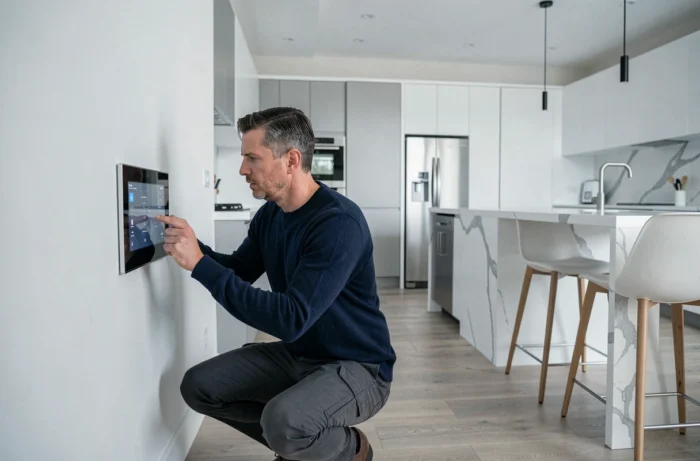
- A programmable connected thermostat provides measurable comfort gains and is often the best entry point into home automation, without installation complexity.
Useful home automation starts with a thermostat and programmable lighting, not with a voice assistant controlling the shutters. Additional layers are added gradually, based on real needs observed after a few months of occupancy.
The choice of equipment for a modern home is less about the catalog than about the technical preparation of the dwelling. Electrical panel, coherence of the heating system, ventilation adapted to the structure: these upstream decisions avoid costly reworks and ensure that each device operates under the conditions intended by the manufacturer.