
Creative hobbies encompass any manual or artistic activity practiced outside a professional setting, with the intention of personal production. Embroidery, modeling, watercolor, sewing, paper work: the spectrum is broad, but the common denominator remains the act of creation. Recent scientific syntheses show that these practices, when regular, produce measurable effects on anxiety and quality of life.
Autonomy and competence: what makes a creative hobby truly beneficial
Most guides recommend “jumping in” to a creative activity without specifying what makes the difference between a frustrating session and a restorative moment. Research in psychology provides a concrete answer.
Recent studies on intrinsic motivation indicate that welfare depends less on aesthetic results than on the feeling of autonomy and competence experienced during practice. Choosing one’s activity freely, progressing at one’s own pace, feeling capable of completing a project: these three conditions matter more than the beauty of the finished object.
In practice, this means that a punch needle workshop attended out of social obligation produces fewer positive effects than a coloring session chosen out of desire. The most reliable selection criterion for a creative hobby is neither trend nor difficulty, but the fit between the activity and personal preferences.
To explore different avenues and find one that matches your desires, the hobbies on Graines de Blogueuses offer various angles that go beyond the classics of DIY.
Creative paper activities: accessible and underestimated techniques
Paper remains the most accessible material to start with. Its cost is negligible, it requires no specialized equipment, and the available techniques cover a very wide range of difficulty.
Origami and modular folding
Classic origami (crane, box, flower) can be mastered in a few minutes with a tutorial. Modular origami, which assembles dozens of identical modules to form a three-dimensional structure, extends the practice over several hours without ever becoming repetitive. Each module is simple, but the assembly requires method.
Paper cutting and scrapbooking
Paper cutting offers one of the best investment-return ratios among all creative hobbies. A precision cutter, a cutting mat, and paper are enough to produce wall compositions, cards, or lamps.
Scrapbooking combines cutting, gluing, and layout around photos or memories. Both activities share a common point: they engage concentration on fine gestures, which fosters a state of focus similar to active meditation.
Textile and creative sewing: going beyond simple mending
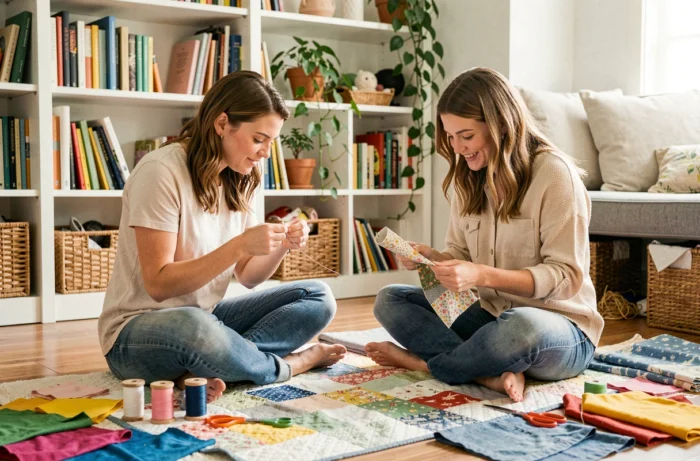
Creative sewing is not limited to making clothes. Several textile practices require little material and adapt to short sessions.
- Contemporary embroidery: a hoop, thread, and a needle are sufficient. Abstract or botanical patterns are well-suited for beginners, and each piece can be framed as an interior decoration element.
- Punch needle: this relief embroidery technique uses a perforating needle to create thick textures on a canvas. The repetitive gesture is quick to learn, and the visual result is immediate.
- Plant dyeing: coloring fabrics with plants (onion skins, turmeric, red cabbage) transforms fabric scraps into unique pieces. The process involves a degree of experimentation that renews interest with each attempt.
Textiles have a specific advantage: each creation produces a functional or decorative object. An embroidered cushion, a dyed tote bag, a handmade pouch – the result integrates directly into daily life.
Modeling and ceramics without a kiln: working with volume at home
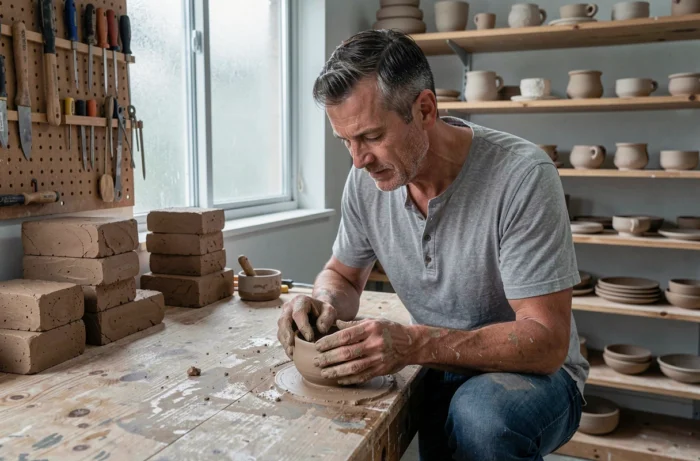
Access to a pottery wheel or a ceramic kiln often hinders beginners. Air-dry clay removes this obstacle. It can be worked by hand, dries in the open air in one to three days depending on thickness, and can then be painted with acrylic or varnish.
Air-dry clay allows for modeling decorative objects without any firing equipment. Bowls, candle holders, small vases, wall ornaments: the possibilities cover both interior decoration and personalized gifts.
For those seeking a more structured practice, pottery workshops offer occasional modeling or throwing sessions. These classes allow you to try working on a wheel without investing in equipment. Most workshops accept complete beginners and provide everything needed, including firing.
Creative hobbies and cognitive protection: a rarely addressed angle
Beyond relaxation, manual creative activities play a role in maintaining cognitive functions. Longitudinal studies conducted on thousands of older adults show that regular practice of creative activities is associated with a reduced risk of cognitive decline.
This finding is not limited to seniors. The mechanisms involved (fine motor coordination, spatial planning, concrete problem-solving) can be exercised at any age. An adult practicing modeling, sewing, or paper cutting engages different neural circuits than those activated by screen work.
Arts on prescription programs, already in place in several countries, incorporate creative workshops as a complement to standard treatments for anxiety and depression. The results are deemed clinically significant when participation reaches at least one session per week over several consecutive weeks.
The choice of a creative hobby benefits from being guided by two simple criteria: the pleasure felt during practice and the possibility of regularity. An activity practiced for twenty minutes three times a week produces more effects than an exceptional three-hour workshop. The material matters less than consistency.