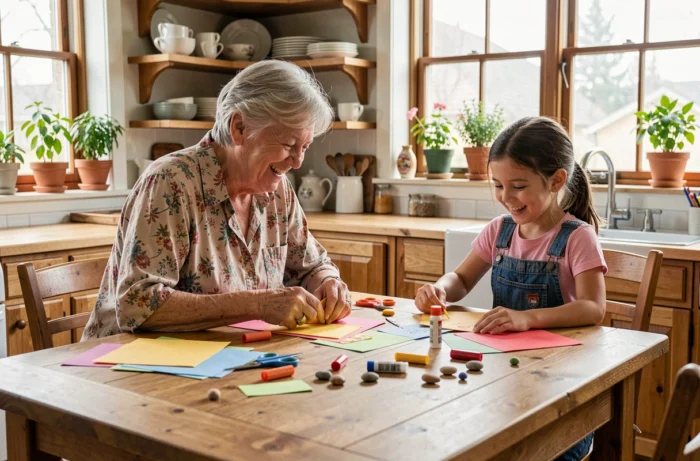
A rainy Sunday, three children of different ages, and the television playing on repeat. We all know that moment when you have to find an engaging activity that works for everyone, from the youngest to the oldest. The reflex is often to look for fun and educational activities for the family without quite knowing where to start or how to prevent one from getting bored while the other has fun.
Hybrid physical-digital games: the angle that classic lists overlook
We often think of crafts or outings to the park. But for a few years now, a category of family leisure activities has quietly developed: hybrid games that combine physical manipulation and digital content. Specifically, we’re talking about connected board game platforms, augmented reality trails in museums, or collaborative apps where parents and children solve puzzles projected in their living room together.
The advantage is that the level of difficulty adjusts. Some adaptive interfaces use artificial intelligence to offer challenges calibrated according to the player’s age. A six-year-old and a teenager can thus participate in the same game without one losing interest.
This format works particularly well on themes like ecology, local history, or cultural discovery. Collaborative parent-child game trails have emerged where learning happens through exploration, not through lessons. To explore other options suitable for each age group, you can check the activities on the Tout Mon Monde website, which lists this type of format.
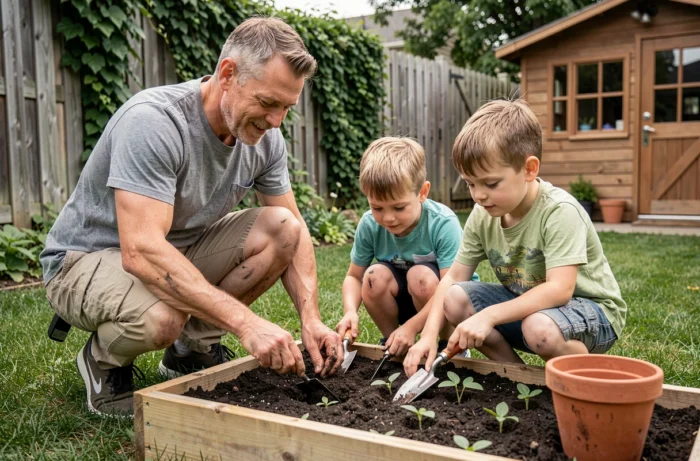
Educational outdoor activities: family slow tourism as a learning framework
Taking your children to the forest seems simple. In practice, the walk can quickly turn into a chore if you haven’t planned a guiding thread. This is where family slow tourism changes the game: we slow down the pace, stop, and observe.
A botanical trail with a sketchbook keeps an entire family occupied for two hours. We identify leaves, compare barks, and note what we find. No need for expensive materials: a pencil, paper, and possibly a free plant identification app.
Feedback varies on this point, but some families prefer to structure the outing around a specific goal rather than leaving the walk open-ended. For example:
- Collect five different types of stones and classify them by color or texture upon return
- Photograph insects to create a mini naturalist album at home
- Follow a watercourse for a few hundred meters while noting changes in vegetation
This type of outing works in all seasons. In winter, we track animal tracks. In spring, we follow the evolution of a bud week by week. Learning is built through repeated observation, not through an isolated outing.
Educational escape games at home: practical organization for a family evening
Setting up a home escape game requires a bit of preparation, but the result is worth it. We’re talking about one to two hours of gameplay for a complete evening, with an initial setup investment of about thirty minutes.
Building a scenario suitable for the ages present
The classic trap is to aim too high for the little ones or too low for the older ones. One effective solution is to create two levels of clues for the same puzzle. The younger ones receive a visual clue (a drawing, a color), while the older ones get a textual or mathematical clue. Everyone searches in parallel, and solving the puzzle requires both answers.
For the theme, we can rely on what the children are studying in class. An escape game about volcanoes after a science chapter, another about knights after a castle visit. The connection to recent learning reinforces memorization without feeling like doing homework.
Materials and staging with what we have on hand
No need to buy a kit. We use envelopes, code locks (retrievable), flashlights, and tracing paper. A shoebox locked with a padlock becomes a convincing treasure chest for a seven-year-old.
- Hide clues in books, under cushions, in the garden if the weather permits
- Time the game to add playful tension (adjust the time according to age)
- Plan a collective reward: a dessert to prepare together, a movie chosen by the winning team
- Alternate roles: in the next session, the children create the scenario for the parents
Reversing roles transforms the game into an exercise in planning and writing. A teenager designing an escape game for their parents engages organizational, logical, and storytelling skills without realizing it.
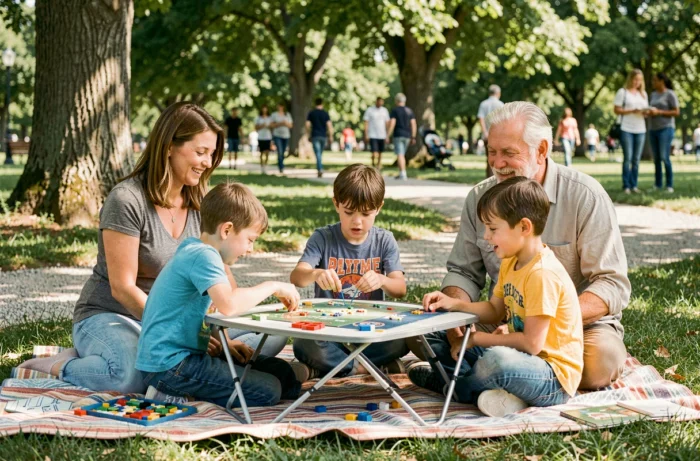
Interactive cultural activities: beyond the classic guided tour
Museums and cultural venues have significantly evolved their offerings in recent years. Augmented reality trails allow children to visualize a historical scene directly in the exhibition hall, tablet in hand. It is no longer a passive medium: the child interacts, answers questions, and unlocks stages.
Some devices go further by offering collaborative platforms where families co-create content during their visit. We draw a character, record a voice, contribute to a collective digital mural. The memory of the outing is no longer limited to a photo in front of a painting.
For families who prefer to stay at home, artistic education projects initiated by schools sometimes continue on weekends in the form of workshops open to parents. These formats, funded through collective initiatives, provide access to practices (printmaking, ceramics, shadow theater) that one might not think to seek out alone.
Choosing between an outdoor activity, an educational board game, or an interactive cultural outing depends less on the budget than on what we want to share. The common point among all these options remains the same: a successful family activity involves everyone at the same level, not an adult supervising while the children execute.