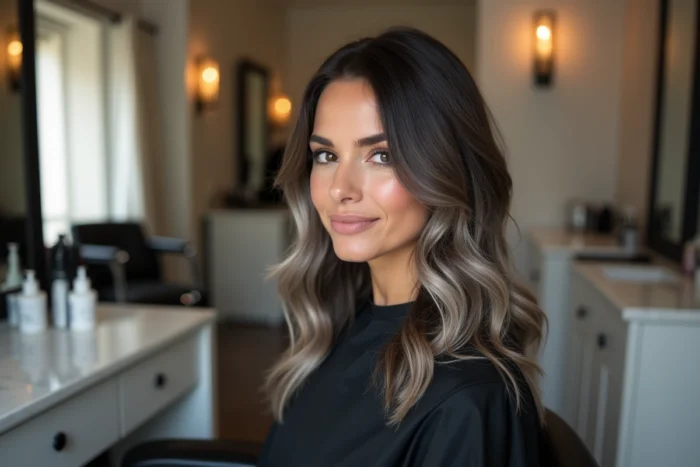
Grey blending on brown hair is not just about placing a few light strands on a dark base. The contrast between medium or dark brown and silver highlights requires precise technical choices: the number of strands, application method, and priority treatment areas. These parameters determine whether the result is luminous or, conversely, a washed-out effect that is unflattering. Comparing the available approaches helps identify the one that suits each profile of brown hair.
Grey blending techniques on brown base: foil highlights, balayage, or block highlights
Specialized salons now distinguish several methods for integrating grey into brown hair. Each technique corresponds to a different type of white hair distribution and level of contrast.
| Technique | Principle | Suitable when | Result on brown hair |
|---|---|---|---|
| Foil highlights | Fine strands wrapped in aluminum foil, controlled lightening | White hairs evenly dispersed | Regular highlights, controlled salt and pepper effect |
| Balayage | Brush application without foil, gradual gradient | Whites concentrated around the face and parting | Natural blend, less pronounced roots |
| Block highlights | Wider sections, pronounced lightening on targeted blocks | High density of whites at the temples or crown | Bold contrast, more visible dimension |
On a brown base, balayage produces a subtle gradient that softens the demarcation between grey roots and colored lengths. In contrast, foil highlights offer a regularity that balayage does not guarantee, making it more suitable for hair where whites appear everywhere without a dominant area.
Adapting grey blending on brown hair to the actual geography of grey remains the factor that distinguishes a harmonious result from a simple generic lightening.

Percentage of white hairs and strand density: the parameter that brunettes underestimate
A common mistake is to request the same number of strands regardless of the stage of greyness. However, colorists adjust the density of the strands based on the percentage of white hairs already present.
When whites represent a small proportion, a few fine strands are enough to create a blend without weighing down the overall look. The brown hair retains its depth, and the grey highlights remain discreet.
As the proportion of whites increases, more strands are needed to avoid a visible gap between the grey areas and the still-brown areas. Increasing the number of strands reduces overall contrast and results in a more uniform appearance.
- Low density of whites: spaced strands, subtle cool tones, spaced maintenance
- Medium density: closely spaced strands around the face and parting, cool gloss between sessions
- High density: extensive coverage at the temples and crown, multiple sessions needed for a gradual blend
This calibration avoids two pitfalls: a grey blending that is too timid and blends nothing at all, or excessive lightening that turns ashy blonde on a brown base.
Progressive sessions on brown hair: why the result doesn’t happen all at once
On a brown base, especially when the lengths have old colorations, a direct transition from dark brown to silver is not recommended. The pigments accumulated in the hair fiber react unpredictably to lightening. An undesirable coppery orange may appear, necessitating multiple corrections.
The most reliable strategy relies on a step-by-step approach. The first session targets the most visible areas: around the face, parting, and frontal hairline. The colorist assesses the hair’s reaction before extending the work to the temples and crown during subsequent appointments.
This progression offers a concrete advantage for brunettes: each session refines the contrast without compromising hair health. Abrupt lightening on brown hair weakens the fiber, makes the ends porous, and dulls the color within weeks.

What cold gloss changes between sessions
Between lightening appointments, a cold-toned gloss neutralizes the warm reflections that naturally emerge on a brown base. This semi-permanent treatment deposits a color veil without ammonia, prolongs the silver shine, and prevents the grey blending from turning golden.
The gloss also acts as a tone corrector. On already applied strands, it adjusts the color temperature without altering the hair structure. A cold gloss applied regularly maintains the consistency of the blend between main sessions.
Cool or ashy tones: choosing the right reflection for a brown base
The choice of tone determines whether the grey blending brightens the hair or dulls it. On brown hair, warm reflections (golden, coppery) conflict with the goal of a silver blend. Cool or ashy tones produce a result that is more consistent with natural grey.
- Light ash: discreet, suitable for medium browns wanting a soft salt and pepper effect
- Silver grey: more pronounced, suitable for dark browns with a high proportion of whites
- Cold platinum blonde: creates a bright bridge between brown and white, useful when the natural contrast is very pronounced
- Mushroom blend (brown-grey): intermediate tone that softens the transition without excessive lightening
The classic pitfall on brown hair is choosing a tone that is too light right away. A gap of more than three shades between the base and the strands creates a striped effect, not a blend. It is better to gradually increase brightness over the sessions.
Grey blending on brown hair gains in naturalness when the chosen tone remains close to the cool temperature of natural grey. A colorist who masters this tonal proximity logic achieves a result where the strands blend with the existing white hairs, without visible demarcation. This parameter, more than the application technique, makes the long-term difference.