
The Champions League final attracts several tens of thousands of requests each year for a very limited number of tickets. Since 2026, the UEFA public ballot reserves an even smaller share of tickets for the general public, making the process of obtaining them particularly selective. Understanding the allocation mechanisms and regulatory conditions helps avoid false leads and focus efforts on channels that are truly accessible.
UEFA Ballot and Neutral Tickets: Statistically Low Chances
UEFA organizes a lottery (ballot) open to supporters without affiliation to a finalist club. On paper, this route seems the simplest. In reality, the share of neutral tickets is very low compared to the stadium capacity.
The majority of tickets are allocated between the two finalist clubs, UEFA sponsors, national federations, and commercial partners. The public ballot captures only a residual fraction of the total capacity.
Field feedback varies on the actual selection rate via this lottery. Some editions show request-to-available ticket ratios that render individual probability negligible. Relying solely on the neutral ballot is akin to betting on a stroke of luck, not building a strategy.
For those who wish to buy a Champions League final ticket by leveraging multiple avenues, the rest of this article details concrete paths to activate well before kickoff.
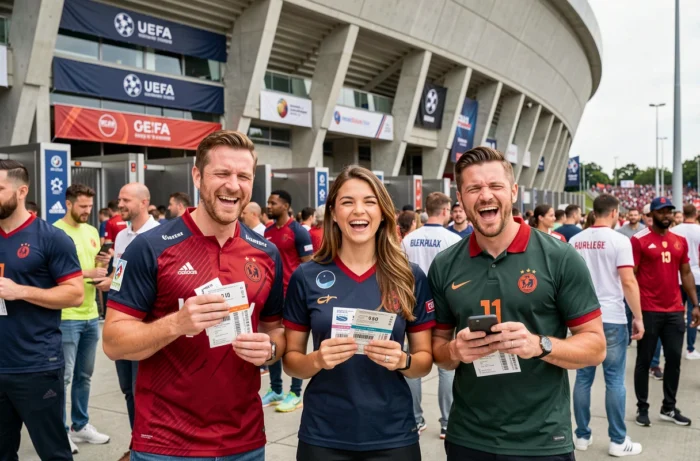
Club Loyalty and Membership: The Most Decisive Lever for the Final
In recent years, clubs qualified for the final have reserved their ticket allocation for their most loyal subscribers and members. PSG, during its 2025 final, for example, organized sales in several waves exclusively for season ticket holders, sorted by seniority and attendance history.
Being in the supporter database of a club likely to reach the final is now the most determining factor. Loyalty point systems, credits for attending away European matches, and subscription seniority serve as sorting criteria.
What This Means in Practice
- Subscribe to a membership or season ticket for the club you follow, ideally several seasons before the targeted final, to accumulate loyalty points
- Attend away European matches during the group stage and knockout rounds, as these trips generate priority credits in most club ticketing systems
- Monitor the club’s official communications starting from the quarter-finals, as the registration windows for sales waves are often short (a few days)
This approach requires an investment over several seasons. It is not instantaneous, but it is the only one that offers a reasonable probability of obtaining a ticket at face value.
Named and Dematerialized Tickets: The End of Informal Transfers
UEFA has gradually generalized dematerialized and named tickets for the final. This evolution has a direct consequence on purchasing strategies: informal ticket transfers between individuals have become very risky.
The ticket is linked to the identity of the holder and, in most cases, to a specific smartphone. Sharing QR codes, purchasing for a third party, or reselling in discussion groups no longer guarantees access to the stadium. An identity check at the entrance can lead to outright denial.
Constraints to Anticipate Before Any Purchase
Preparing to travel yourself and having a dedicated smartphone is now a condition for the ticket to be usable. Buying a ticket “for a friend” or “in someone else’s name” exposes you to cancellation without refund.
Official resale platforms (when they exist) remain the only secure channel for transfers between individuals. Outside of this framework, the risk of showing up at the stadium with an invalidated ticket is real.
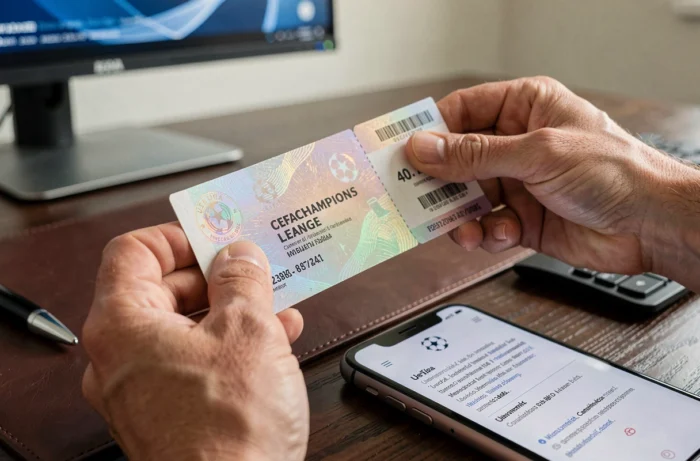
Secondary Market and Hospitality Packages: What to Know About Prices
UEFA regulations govern the prices of “supporter” tickets for away matches, including the final. A price ceiling applies to the cheapest categories. However, hospitality packages marketed by UEFA or its partners are not subject to this ceiling and reach significantly higher amounts.
On the unofficial secondary market, prices soar. Tickets resold outside authorized channels often exceed several times the face value, without any guarantee of validity. UEFA prohibits unauthorized resale and can cancel any ticket detected on a non-partner platform.
- Hospitality packages generally include access to the stadium, catering, and sometimes accommodation, but their cost makes them accessible only to corporate clients or those with very large budgets
- Price comparison platforms (like Ticket-Compare) allow you to check price discrepancies between resellers, but they do not eliminate the risk of cancellation by UEFA
- Some specialized travel agencies offer packages that include the ticket, with variable contractual guarantees that should be examined clause by clause
The distinction between the official market and the gray market remains unclear for many buyers. A low price on an unknown site should raise as much concern as an exorbitant price.
Timeline and Anticipation: When to Act for the Final
The window of action to maximize your chances does not open at the time of the semi-final draw. It begins months, even seasons in advance.
Registration for the UEFA ballot generally occurs a few weeks after the finalists are designated. The timeframe is short, and tickets sell out within hours for club waves. Waiting to know the matchup before starting your efforts means you are already behind the best-positioned supporters.
The typical timeline follows a simple logic: club membership at the beginning of the season, accumulation of attendance credits during the European campaign, then registration for sales waves as soon as qualification is announced. Missing any step reduces the remaining options.
The Champions League final remains one of the most difficult sporting events to access in the world. No trick replaces long-term preparation, rooted in loyalty to a club and understanding of official channels. Shortcuts exist, but they almost always come with financial risk or denial of entry to the stadium.