A student in a primary school autism support unit (ULIS TSA) who raises their hand to ask for a sensory break instead of having a meltdown has made progress. Nothing will change on their report card. In the classroom, everything will have changed. This distinction between academic achievement and adaptive skills lies at the heart of supporting autistic students in primary school, and it is often what puzzles families and mainstream classroom teachers alike.
Measuring progress for an autistic student in a ULIS TSA beyond grades
In a mainstream classroom, students are assessed on their results in French and mathematics. In a ULIS TSA, the first signs of progress appear in areas that traditional school assessment grids do not capture: independence, functional communication and sensory regulation.
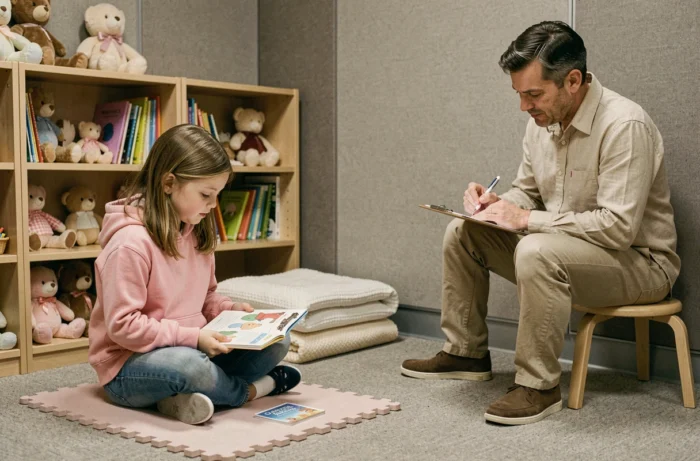
A child who manages to make a verbal request instead of shouting, tolerates the noise in the cafeteria for ten minutes longer than in September, or puts on their coat by themselves after six months of practice is reaching major milestones. To make this progress visible, the ULIS coordinator and the designated special education teacher can use functional observation grids, completed as a team with the AESH (support worker for students with disabilities).
For example, they can record how often a target behavior occurs (the number of meltdowns per week, or the number of transitions completed without physical assistance) and compare the results over several months. This longitudinal tracking, even when done informally, helps parents see tangible changes during school support team meetings (ESS). The support provided in primary school ULIS TSA programs is based precisely on this approach: adapting success indicators to each student’s profile.
Structuring time and space: the foundation of support in autism ULIS programs
Before discussing adapted teaching, we need to talk about the environment. A student with autism who does not understand where they need to go, what will happen next, or how long an activity will last cannot learn. How the space is arranged and how predictable the schedule is determine everything else.
Visual tools and individualized schedules
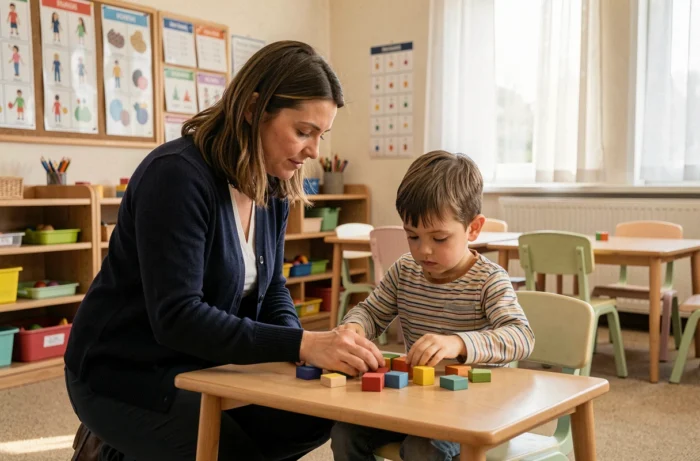
Visual timers (Time Timer or equivalent), picture schedules displayed on the wall, and tasks broken down into numbered steps are commonly used in ULIS TSA programs. Their effectiveness depends on consistency: the same color code, the same place in the room, and the same transition routine between activities.
A common mistake is to introduce too many tools without maintaining them over time. An autistic child who has learned to use a visual communication system in the ULIS may feel lost as soon as they join their mainstream classroom if their regular teacher does not use the same cues. Coordination between the ULIS coordinator and mainstream classroom teachers is therefore a direct driver of progress.
The AESH’s role in generalizing skills
A support worker for a student with disabilities (AESH) is not a tutor. Their role is to help transfer skills learned in the ULIS to mainstream classroom activities. In practice, this means the AESH needs to know the goals in the student’s individualized schooling plan (PPS) and the strategies put in place by the coordinator.
When the AESH is only available for a few hours a week (which is still common due to insufficient support allocations), the coordinator needs to prioritize the times when one-to-one support has the greatest impact: mainstream classroom activities, recess and lunch. The more structured small-group sessions in the ULIS classroom are often when the student needs the least support.
Adapting academic learning for primary school students with autism
Once the environment is stable, the question of teaching methods arises. Autism spectrum disorders affect the processing of implied meaning, cognitive flexibility and the understanding of complex instructions. Adaptations focus on three main areas:
- Rephrasing instructions: give one short instruction at a time and pair it with a visual aid. Avoid double negatives and metaphors (“underline the words that jump out at you” does not work for a student who interprets language literally).
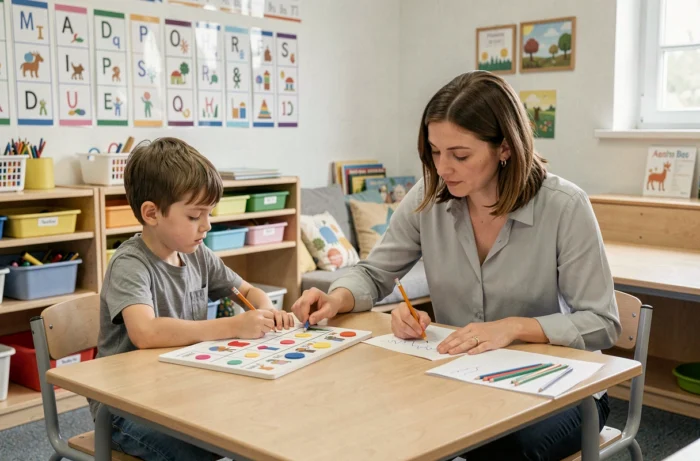
- Breaking tasks into smaller steps: a worksheet with ten questions can be divided into two or three sections, with a break or a reward between each one. Reducing the amount of work does not mean lowering the learning objective; it means adapting the format.
- Using special interests as a learning tool: a student who is passionate about dinosaurs will make more progress in reading a paleontology text than a prescribed work of fiction. Using specific interests to engage students in learning is one of the most effective and least costly adaptations.
Mainstream classroom inclusion: what makes a difference day to day
The goal of the ULIS is not to keep students in a separate program, but to enable them to spend time in mainstream classrooms in ways that are genuinely beneficial. An inclusion period that is poorly planned, where a student has to cope with noise and unpredictability without support, can lead to more setbacks than progress.
Preparing for inclusion means informing the receiving classroom teacher about the student’s sensory profile, meltdown triggers, communication methods and strengths. A one-page summary prepared by the ULIS coordinator is often enough to prevent misunderstandings.
Peers as a factor in social learning
Interactions with mainstream classmates provide learning opportunities that the ULIS classroom cannot replicate. For these interactions to be positive, students in the mainstream class benefit from simple explanations about how their autistic classmate experiences the world, without dramatizing the situation or using medical terminology.
A student who understands that their classmate does not make eye contact because it feels uncomfortable for them, rather than because they are being rude, will naturally adjust how they interact. This awareness-raising, led by the teacher or coordinator, reduces rejection and encourages spontaneous interactions.
Supporting an autistic student in a primary school ULIS program is not just a matter of staffing or adapted materials. Coordination among all the adults working with the child, consistent visual tools across settings, and progress indicators that go beyond strictly academic measures all determine the quality of the student’s education.
When an autistic child learns to ask for help instead of withdrawing, that is a skill that will serve them well beyond primary school.