Turning over garden or vegetable patch soil is still an ingrained habit. It may seem simple, but the results depend less on how much effort you put in than on the tool you choose and when you use it. Every soil responds differently depending on its texture, moisture level and growing history, making the choice of a tool for turning soil more technical than it might seem.
Clay, stony or loose soil: the right tool depends on the texture
Loose soil, rich in organic matter and well structured, can be worked with almost any hand tool. A broadfork is ideal: its tines penetrate easily and aerate the soil deeply without turning it over completely. On a clear vegetable bed, it is the fastest tool to use.
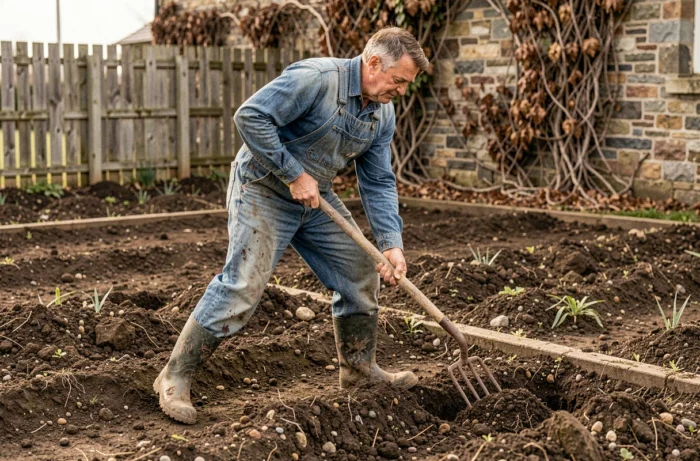
Things get more complicated with clay or compacted ground. A broadfork may struggle to penetrate dense clay, and its tines can bend in very stony soil. A digging fork, used in small sections, is better suited to compacted soil or ground scattered with obstacles. It lets you lift and loosen the soil in smaller areas without putting too much strain on the handle.
On stony ground, a traditional flat-bladed spade catches on every stone and sends the impact through your wrists. A digging fork can work around stones thanks to its spaced tines. For a flower bed crowded with roots or stones, it remains the most versatile option.
Finding the right tool for turning soil easily therefore starts with looking at what is underfoot, not at what catches your eye on the store shelf.
Working soil that is too wet: the trap that ruins its structure
The condition of the soil when you work it matters just as much as the tool itself. In clay soil, working when the earth sticks to your tools compacts it and creates clods that are difficult to break up. This smearing creates a compacted layer beneath the surface, blocking drainage and root growth for several seasons.
The test is simple: take a handful of soil and squeeze it. If it forms a shiny ball that does not crumble, the soil is too wet to work. Wait until it has drained enough to be workable—that is, still slightly moist but crumbly to the touch.
This point is rarely mentioned in tool-buying guides, which focus on blade shape or handle weight. A perfectly suitable tool used at the wrong time can produce a worse result than doing no work at all.
Spade, digging fork, broadfork and hand cultivator: each tool has its purpose
Choosing a tool means knowing what you want to do to the soil. A spade turns it over, a digging fork loosens it, and a broadfork aerates it without inverting the layers. This distinction affects the soil’s biological life.
- A flat-bladed spade buries crop residues and exposes deeper layers. It is suitable for clearing a plot that has never been cultivated or is overrun with perennial weeds, but it disrupts soil life (earthworms, microorganisms) by inverting the layers.
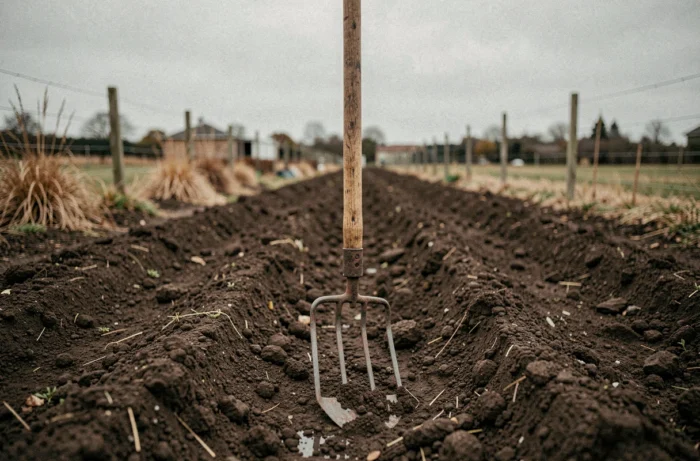
- A digging fork lifts and breaks up the soil without turning it over completely. It works especially well in heavy soil, around stumps and in established beds where a spade would cut the roots of neighboring plants.
- A broadfork (or biofork) is pushed vertically into the soil, then levered back to lift it. It preserves the soil’s natural layering and puts less strain on your back thanks to its double handle. It works best on relatively clear ground that is not too stony.
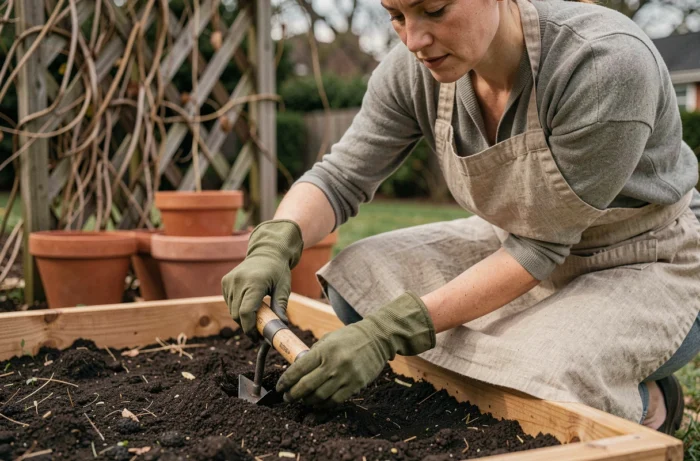
- A hand cultivator (or claw) and a rake are used afterward, once the soil has been loosened. They break up clods, level the surface and prepare a fine seedbed. There is no point using them on soil that has not been loosened first.
In other words, a hand cultivator does not replace a broadfork, and a broadfork does not replace a digging fork. Using the right tools in sequence is better than relying on a single all-purpose tool.
Should you still turn over soil in a vegetable garden?
It is worth asking, because there is no single answer for every situation. In soil that has been cultivated for several years, regularly mulched and enriched with compost, turning it over is often unnecessary. A pass with a broadfork at the end of the season is enough to loosen the soil without destroying the mycorrhizal network or burying organic matter on the surface.
However, no-dig gardening may require a transition period on compacted soil. Ground that has never been worked or has been left bare for years often develops a surface crust that mulch alone will not fix in the first season. In that case, an initial pass with a spade or digging fork, followed by a generous application of organic matter, is still the most direct way to bring the soil back to life.
Fertile soil and the right tool: two connected factors
Preparing fertile soil is about more than mechanical work. The tool you choose determines how deeply and in what way the soil is worked, but compost, composted manure or organic mulch is what actually nourishes it. Soil turned with a spade and then left bare deteriorates faster than soil simply aerated with a broadfork and then covered.
The best approach is to combine a loosening tool suited to your soil with permanent ground cover. Covered, minimally disturbed soil produces more than bare soil turned over every season. The tool makes the work easier; the mulch does the rest.