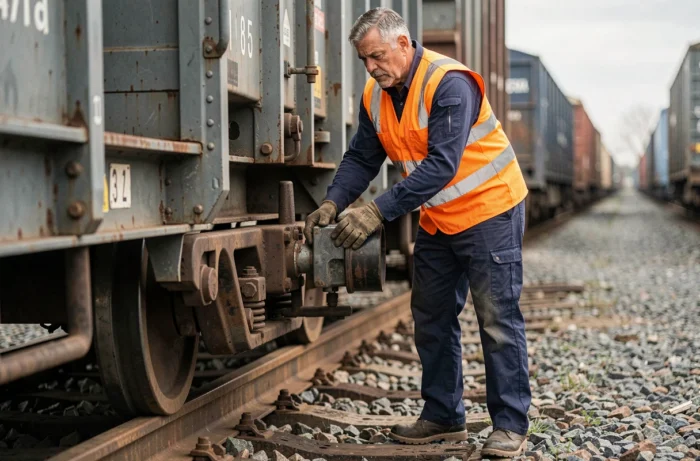
Vehicle records, train composition, brake sheets, fitness-for-transport checks, compliance with the RID regulations for dangerous goods: a wagon handler’s or wagon inspector’s day covers a wide range of operational and administrative tasks, going far beyond shunting wagons in a marshalling yard.
These operational and administrative tasks shape every shift, with responsibilities varying in scope depending on the employer, site and type of goods handled. What really distinguishes these two job titles, and what challenges do these rail professionals face in their day-to-day work?
Railway safety and dangerous goods: the regulatory foundations of a wagon handler’s role
Competitors often highlight a passion for railways or training pathways. They spend less time on what actually takes up most of the working day: regulatory obligations. The decree of 2 May 2017 requires employers to inform and train workers about the risks associated with railway premises, then issue them with written authorization after verifying their theoretical and practical knowledge. Without this document, access to the tracks is prohibited.
For wagons carrying classified materials, the RID regulations (Regulations concerning the International Carriage of Dangerous Goods by Rail) add another layer of requirements. The wagon handler must check the load, inspect safety equipment and ensure that the labels match the declared contents. An error on a hazard pictogram or identification number can hold up an entire train, or even expose the employee to criminal liability.
Understanding the work of a wagon handler and wagon inspector means recognizing the weight of this paperwork, which goes far beyond the image of a shunting operator.
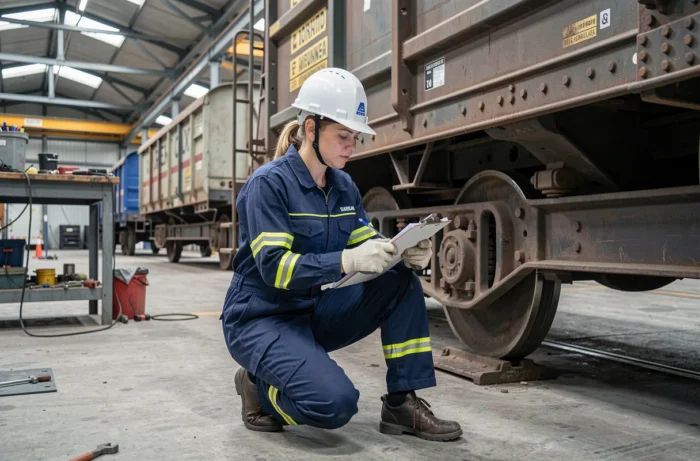
Wagon handler and wagon inspector: a comparison of duties and responsibilities
The two terms are sometimes used interchangeably. In practice, the job title varies between railway companies and collective agreements. The table below summarizes the differences found in the job listings and role descriptions reviewed.
| Criteria | Wagon handler | Wagon inspector |
|---|---|---|
| Main scope | Shunting, coupling and sorting wagons at stations or in marshalling yards | Technical inspections, fitness-for-transport checks and traceability |
| Documentation | Brake sheets, train composition | Vehicle records, RID forms, inspection reports |
| Dangerous goods | Following basic instructions | Thorough checks of the load and safety equipment |
| Regulatory training | Written authorization after training (decree of 2 May 2017) | Same, with additional modules depending on the site |
| Typical hours | Shift work, potentially including weekends and public holidays | Similar shifts, sometimes on a three-shift rotation |
The distinction between the two roles is not always clear-cut. At some sites, one employee performs both functions. The difference is most pronounced at facilities handling large volumes of classified dangerous goods, where the wagon inspector’s specialist documentation skills become essential.
Documentary traceability: what really shapes the working day
A common misconception is that these jobs are primarily physical. There is certainly hands-on work, but documentary traceability accounts for an increasing share of working time. Every wagon arriving in a yard is recorded: registration number, condition of the running gear, load compliance and date of its last overhaul.
The brake sheet, prepared before every departure, makes the employee accountable. It certifies that the train’s braking system matches its declared composition. A discrepancy between the number of braked wagons and the actual tonnage can lead the traffic controller to refuse permission to run.
- Vehicle records: identification of each wagon, visual checks of axles, buffers, couplings and the general condition of the body
- Brake sheet: calculation of the percentage of braked mass relative to the train’s total mass, with approval before the train enters service
- RID forms: for each dangerous goods wagon, checking the hazard identification number and hazard labels, and ensuring there are no visible leaks
- Defect report: any fault found (crack, deformation, missing label) must be reported in writing, suspending the wagon’s use
This level of rigor is not optional. A wagon deemed unfit for transport is removed from the train until it has been brought back into compliance, which can delay departure by several hours.
Medical and psychological fitness: a screening requirement for the role
Some SNCF job listings now include medical and psychological fitness as a recruitment requirement for roles involving safety-critical tasks. This requirement does not necessarily apply to every wagon handler or wagon inspector position, but it reflects a trend towards stricter screening at the outset.
Assessments cover vision, hearing, stress tolerance and the ability to work shifts. Working hours ranging from 4 a.m. to midnight, combined with weekend and public holiday shifts, are a practical reality for some of these employees.
Working conditions on railway premises: shift patterns and on-site risks
Working on railway premises involves specific risks: trains moving on adjacent tracks, handling heavy couplings and exposure to the elements in open yards. The access authorization issued by the employer is more than a simple badge: it certifies that the employee knows how to move safely through hazardous areas.
Shift work also brings chronic fatigue, which scheduling teams try to offset through rotating shifts. Conditions vary from one site to another. At a continuously operating marshalling yard, shifts cover all 24 hours. At a smaller site, work is concentrated around arrival and dispatch windows.
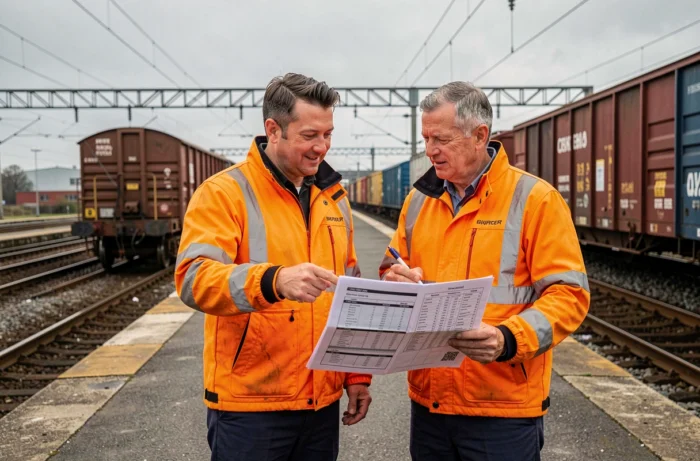
Career development and pathways within the railway sector
An experienced wagon handler can move into roles such as shunting supervisor, traffic controller or train dispatcher. The most common route involves gaining skills in signaling and traffic management. Ongoing training remains the main driver of career progression in this sector, with each new certification opening the door to a broader scope of responsibility.
The wagon inspector role, with its strong focus on documentation and regulations, can also lead to quality control or safety specialist positions within freight railway companies.
These two jobs share one thing that job descriptions often fail to convey: every action and every signature affects the safety of an entire train. The less visible side of the work—forms, inspections and decisions to keep wagons out of service—is just as important as the shunting itself to the day-to-day operation of France’s railways.